What Is an AI Sales Manager? (And What Founders Should Actually Install)
Most "AI sales manager" tools automate CRM busywork. A real one replaces the management layer: remembers every deal, scores deal health, and tells reps exactly how to close.

George
7 July 2026 · 7 min read
Building the AI sales manager. Frame State Selling on every live call.
Search "AI sales manager" and you'll find two very different products wearing the same label.
One camp sells workflow automation: enrich leads, clean your CRM, crunch forecast numbers, and surface risk flags in a dashboard. Useful. But that's RevOps with an AI skin, not a manager.
The other camp, the one that matters if you're a founder running 3 to 10 closers on high-ticket deals, replaces the human management layer itself. It remembers the state of every conversation, tells each rep the next move, and compounds your methodology instead of leaking it out the door with every hire and every departure.
That second definition is what this article is about. If you're evaluating whether to install an AI sales manager, hire a human one, or bolt another point tool onto your stack, start here.
The job an AI sales manager is supposed to do
A sales manager at a founder-led company does four things that no spreadsheet, Gong dashboard, or generic chatbot covers end to end:
- Know where every deal actually stands: not the CRM stage, the real psychological and logistical position.
- Tell each rep what to do next: grounded in how your team sells, not a generic playbook.
- Catch deals before they die: frame slipping, blockers activating, follow-ups going soft.
- Transfer methodology: so performance doesn't live in one person's head.
Most tools labelled "AI sales manager" automate pieces of the admin around those four jobs. Forecasting spreadsheets. Lead scoring fields. CRM hygiene workflows. Deal health percentages.
An installed AI sales manager does the four jobs.
Sales forecasting: numbers vs judgement
Traditional forecasting is a RevOps exercise. Someone exports pipeline data, applies probability weights, and produces a number the board can use. The AI-enhanced version automates the export and the weighting. Faster. Still backward-looking.
A founder doing manager work doesn't forecast by spreadsheet. They read deals:
- Which opportunities have a real decision-maker engaged?
- Which ones are stuck in "think about it" because the frame collapsed?
- Which reps are carrying pipeline that looks full but won't close?
An AI sales manager should answer those questions continuously, not once a quarter when someone asks for a number. The output isn't a forecast slide. It's a ranked list of deals that need attention this week, with the specific move each one requires.
If the tool you're evaluating produces better charts but doesn't change what your reps do on Monday morning, it's forecasting software. Not management.
Deal health scoring: probability vs frame state
Most deal scoring tools measure activity and sentiment. Calls logged. Emails sent. Positive language in the transcript. They output a percentage: 72% likely to close.
Founders know that number is often wrong. A deal can look healthy in the CRM (regular touchpoints, engaged champion, proposal sent) and still be dying because the prospect never owned the problem, the decision environment was never mapped, or the rep started chasing instead of leading.
Deal health for a high-ticket team means reading frame state: is your rep leading the conversation, slipping into compliance, or chasing a prospect who has already mentally moved on? It means tracking buyer signals, hardness and speed of resistance, not just keyword sentiment.
An AI sales manager scores calls and deals against your methodology, not a generic engagement rubric. It flags the deal where the rep sounded confident but lost the decision-maker gate. It catches the "think about it" that is actually a money blocker, not a timing objection.
Probability scoring tells you what might happen. Frame-aware scoring tells you what to do about it.
Qualification: BANT fields vs belief gating
Budget, authority, need, timeline (BANT and its descendants) are fine as CRM fields. Automating BANT lookup (pull budget from enrichment data, infer authority from LinkedIn) saves research time. It does not tell you whether the deal is real.
High-ticket qualification is belief-based:
- Does the prospect accept the problem is real and costly?
- Have they given up on solving it themselves?
- Is there a decision environment (timeline, stakeholders, process) that can actually close?
A rep can tick every BANT box and still lose, because the prospect was never bought in on the problem. An AI sales manager tracks whether those beliefs were built on the call, where they broke down, and what recovery move closes the gap.
The test: after your tool scores a lead, does your rep know what question to ask on the next call? If not, you have a data layer. Not a manager.
Deal risk and momentum: dashboards vs next moves
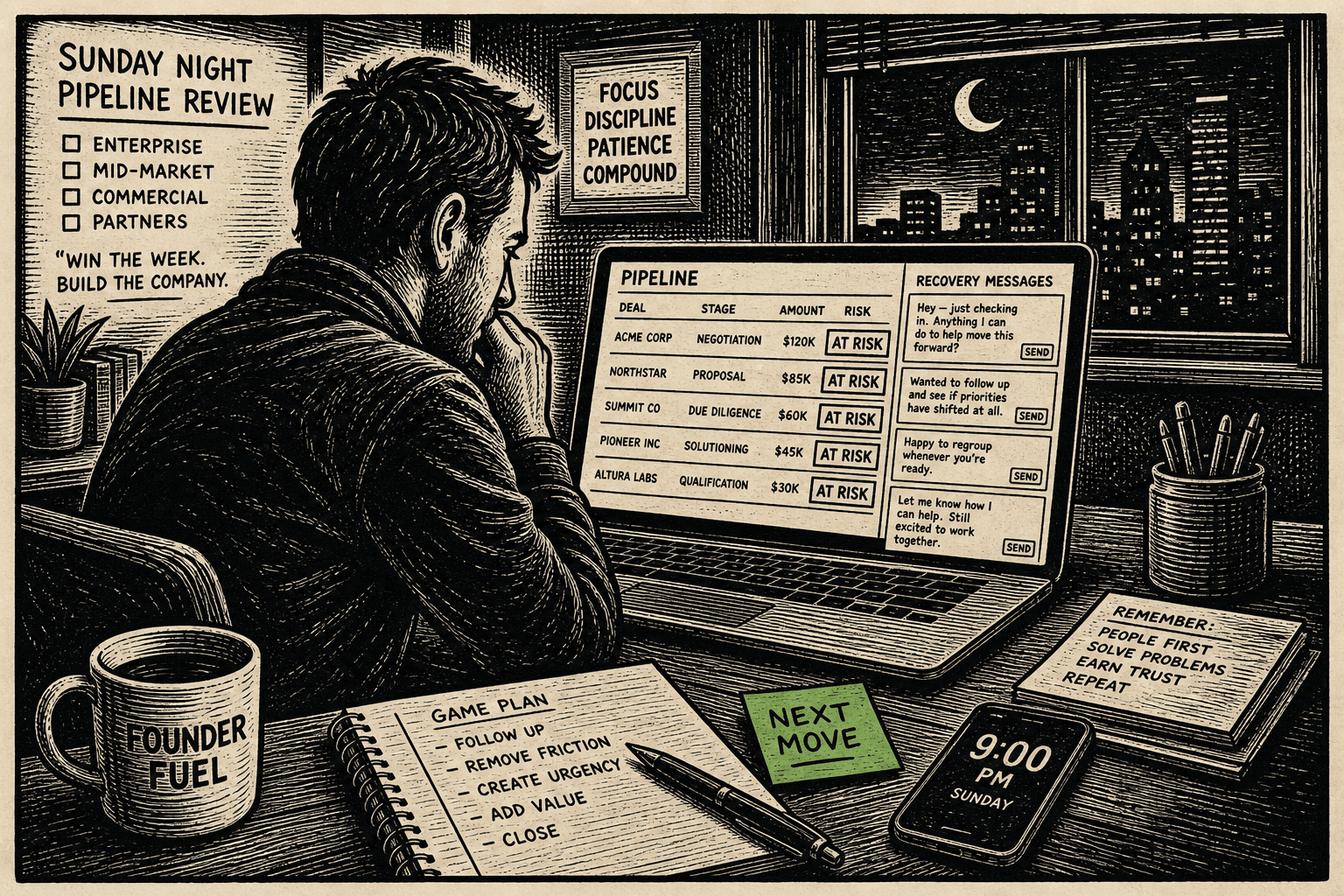
Risk dashboards surface red flags. Momentum indicators show activity spikes. Both are useful for a VP of Sales with a RevOps team interpreting them.
A founder acting as de facto sales manager needs something more operational: drafted recovery moves, specific to each deal's position, ready for approval before the prospect goes cold.
- Marcus hasn't replied in eight days. Here's the re-engagement message based on what he said about the CFO on the last call.
- Tom's contract is unsigned. The blocker is partner approval, not price; here's the move to surface the real decision-maker.
- Cherie's gone quiet. The frame slipped in discovery; here's the follow-up that re-anchors the problem before you send another "just checking in."
That is the Saturday morning story: not a dashboard of risks, but work already done. Moves drafted. Nothing sent without your approval. Monday, Marcus replies.
If the product stops at "deal at risk" without telling you the move, it's monitoring. Management is monitoring plus execution.
Two categories wearing one label
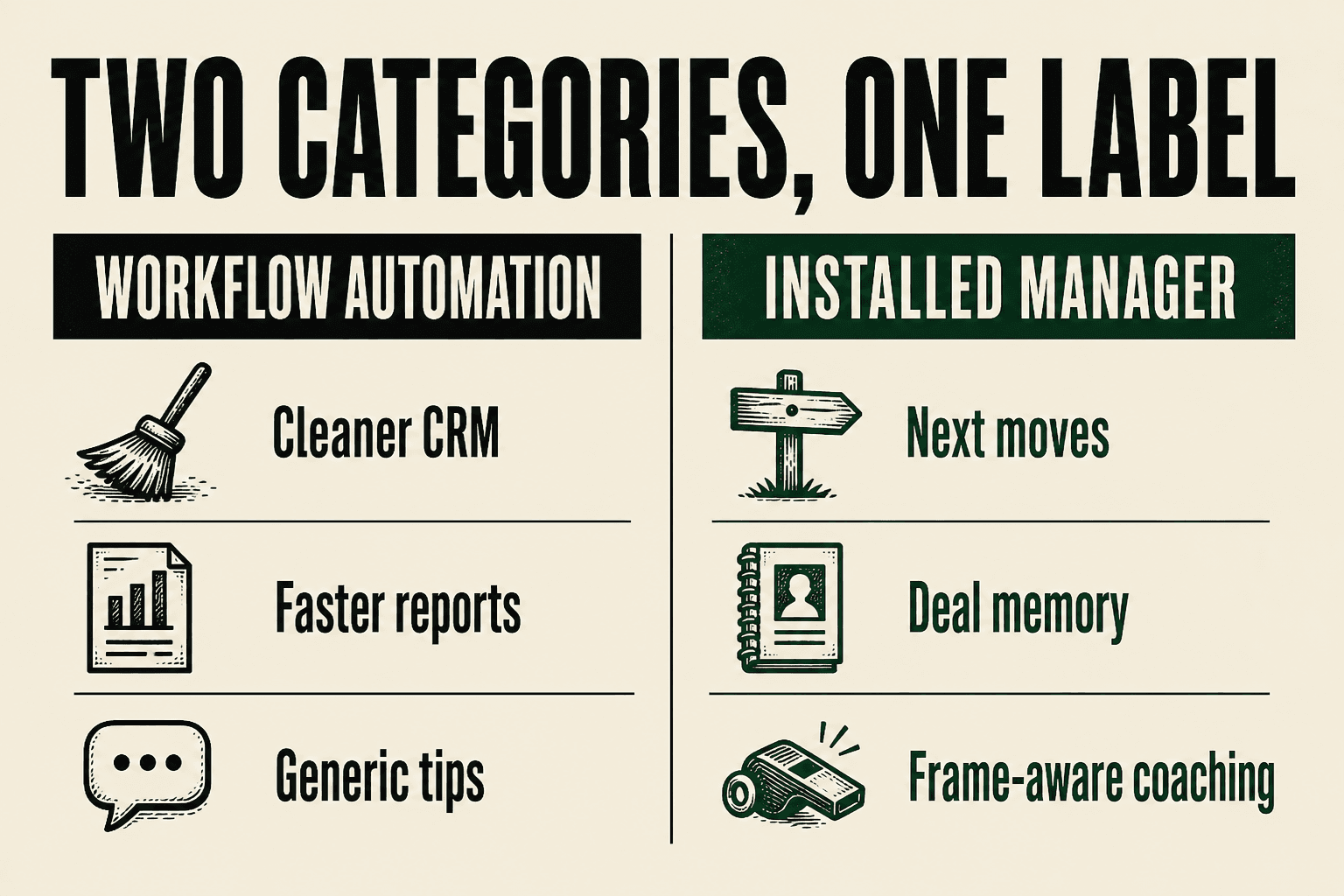
When you evaluate AI sales manager options, sort them into two buckets:
| What you get | Workflow automation | Installed manager |
|---|---|---|
| Primary output | Cleaner CRM, faster reports | Next moves per deal, per rep |
| Remembers | Fields and activity | Conversation state and methodology |
| Coaching | Generic tips or call summaries | Frame-aware moves from your method |
| Who it replaces | Admin hours | The £220K management layer |
| Failure mode | GTM bloat: another tool to configure | Wrong ICP: low-ticket or enterprise CRM shops |
Neither is "wrong." If you need pipeline hygiene and forecast automation, workflow tools deliver that.
If you're the founder who is already the sales manager, reviewing deals Sunday night, jumping on calls to save stalling opportunities, re-explaining the methodology after every new hire, you don't need another workflow. You need the function installed.
What "install" means (and why it matters)
Subscribe is the wrong verb for this category.
A human sales manager takes months to ramp. They sit in on calls, learn your method, build context on every active deal, earn the team's trust. Then they leave and the context walks out with them.
Installing an AI sales manager follows a similar arc, but the context compounds instead of resetting:
- Methodology audit: how your best deals actually close, not the PDF playbook nobody reads.
- Deal memory live: every active opportunity loaded with real conversation state.
- Team onboarding: reps start getting call-specific coaching, not generic scripts.
- Manager view: you see the pipeline the way a great manager would, without doing the work yourself.
That's a four-week standard install for a team, not a credit-card signup and a blank dashboard. The pricing reflects management capacity, not another SaaS seat.
Who this is for (and who should pass)
Good fit:
- Founder or CEO running 3 to 10 closers
- $80K+/month revenue, deals in the £5K to £100K+ range
- You are the bottleneck: the team closes when you're involved and stalls when you're not
- Methodology exists (even if only in your head or your top rep's) and needs to transfer
Wrong fit:
- Pre-revenue or transactional low-ticket sales: you don't have a management problem yet
- Mature enterprise with dedicated RevOps: you need intelligence infrastructure, not a manager replacement
- You want a CRM: activity storage and reporting are different jobs
The question to ask before you buy
Every vendor will say they have an AI sales manager. One question separates workflow tools from the real thing:
After the first month, does my team sell differently, or does my CRM just have better data?
Better data is fine. Selling differently is what a manager does.
If you're at the wall where the hire keeps failing, the methodology keeps leaking, and you're reviewing pipeline on your phone at 9pm, the fix isn't another automation layer. It's installing the management function into software that doesn't leave, doesn't forget, and gets sharper every month.
That's what 1Close is built for: the AI sales manager that always knows what's going on with sales, remembers the state of every deal, and tells your team exactly how to close them.
Written by
George
Founder, 1Close
Building the AI sales manager. Frame State Selling on every live call.
Building the AI sales manager. Writes about high-ticket closing, frame, and how founder-led sales teams actually scale.
Frame State Selling® · Frame Intelligence Engine®
Keep reading
One un-recovered deal per quarter is next year's sales manager
One should-have-closed deal per closer per quarter is the real cost of losing sales deals nobody totals. Bigger than the sales manager you keep parking.
10 August 2026 · 8 min read
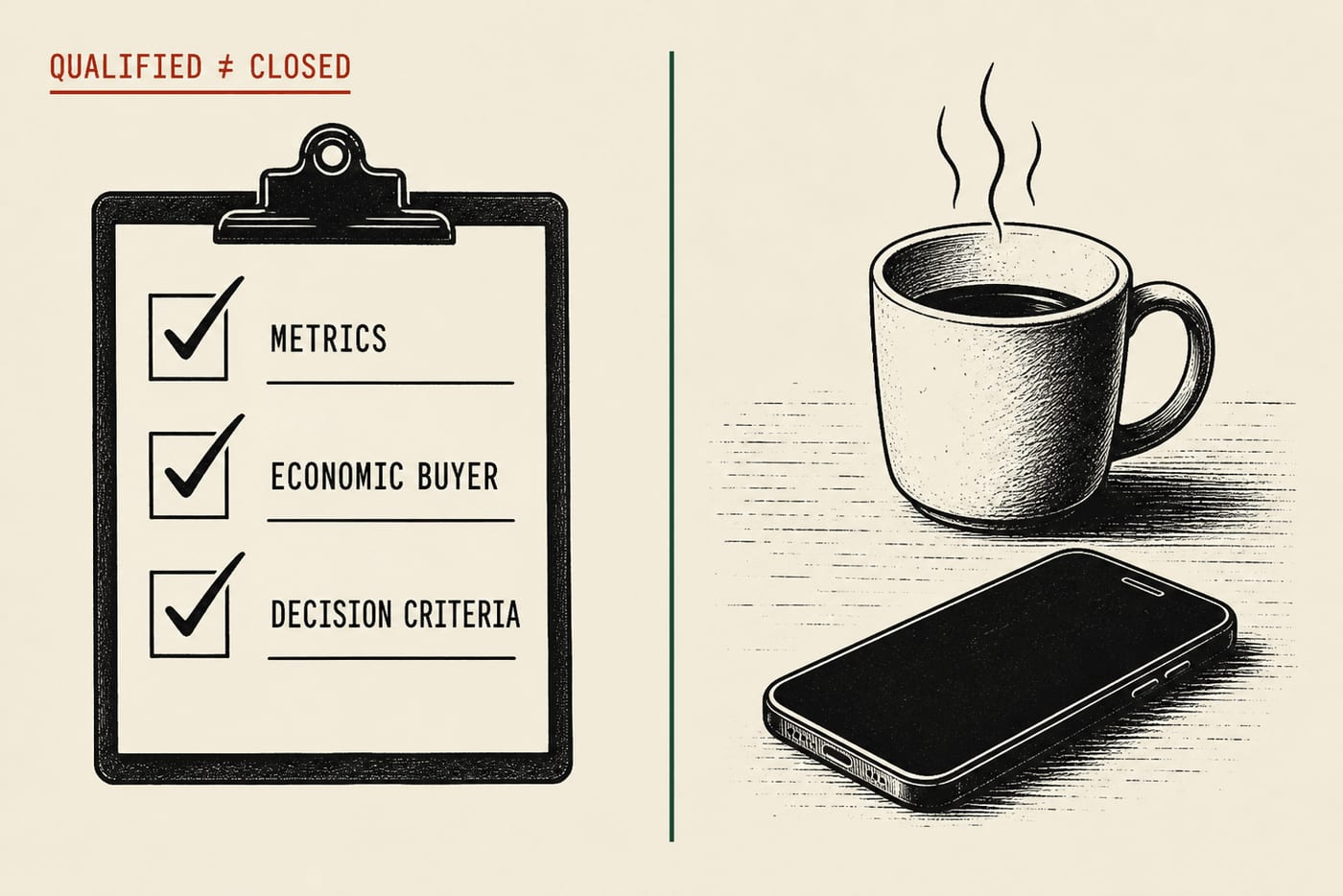
MEDDIC gets qualification right and closes wrong. Here's why.
MEDDIC qualifies the deal. It cannot tell you the frame slipped at 4:32. Founders who stop at the scorecard keep losing deals that were already dead.
8 August 2026 · 8 min read