Free book · For founders, sales managers and closers
Why great sales calls still end in “let me think about it.”
Because your closer said it. The buyer didn’t.
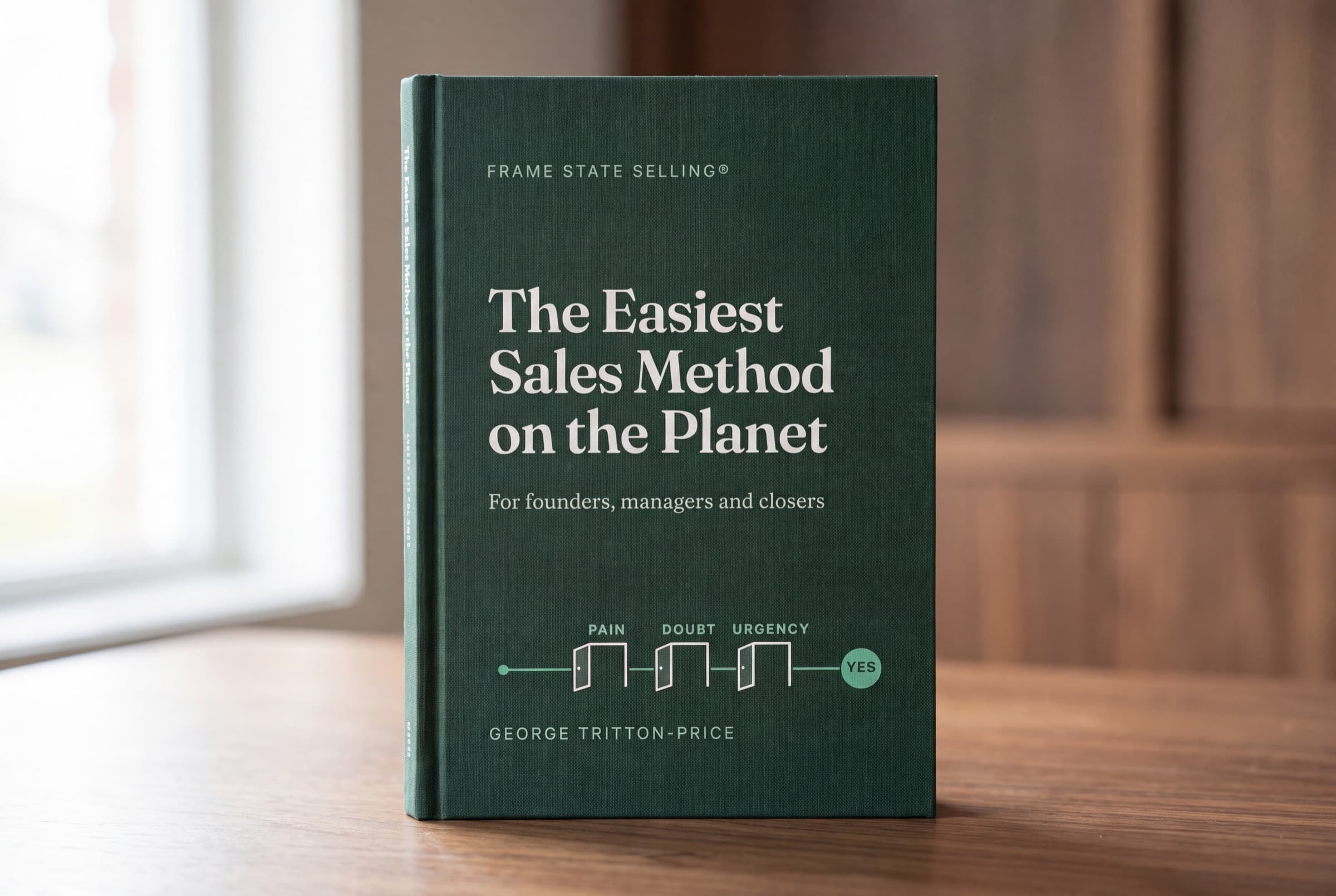
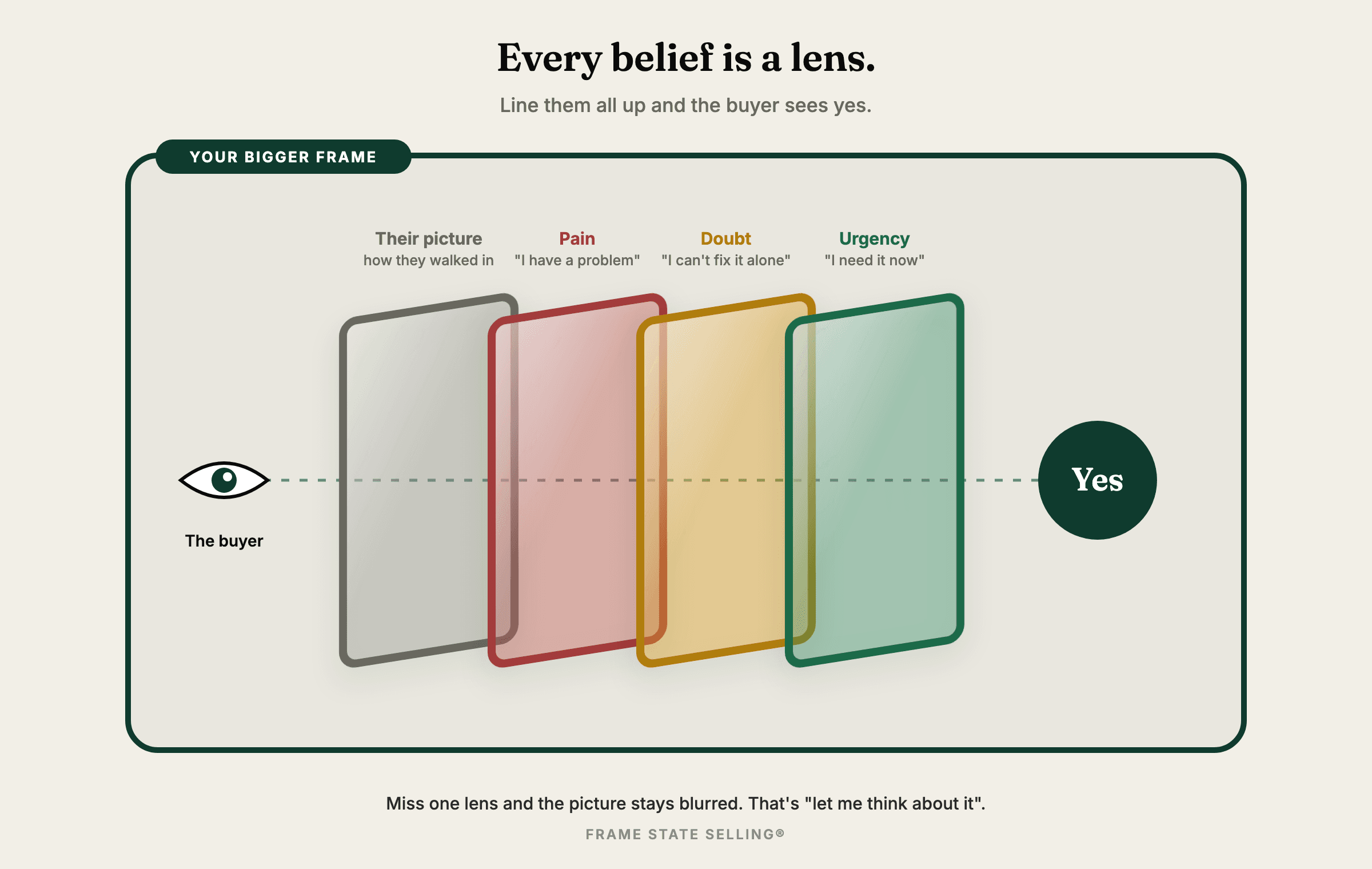
The Easiest Sales Method on the Planet shows your team how to get the buyer to say it themselves: the problem, why they can’t fix it alone, and what waiting costs them. Seven steps, a drawing for every idea, read in an hour. Free as a PDF.
Straight to your inbox. Nothing to buy, no course. Unsubscribe in one click.
If you run a sales team
You can’t hear most of your team’s calls. Here’s what’s happening on them.
- The call feels great, then ends on “let me think about it.” A belief your closer told them is borrowed. It fades on the drive home.
- Your closer offers a discount before anyone asked for one. The buyer never said the price was the problem.
- “I’ll follow up next week” goes in the CRM. That isn’t a next step. It’s a slow no.
- Your nicest closer makes every hard moment comfortable. The deal is dying from kindness, not lack of skill.
None of this is a lead problem. Each one is something the buyer never got to say. The book shows your team what that is, and how to ask for it.
Do the sum before you finish reading: calls a month × the close rate you’re missing × your price. That’s what the misses cost you, every month.
Who it’s for
One book. Your whole team on the same page.
Founders and CEOs
One script. One language.
You can’t coach five different plays. Hand every closer the same book, then run it the way the book sets out: one call each, every week, count the misses, one drill.
Sales managers
A test for any recording.
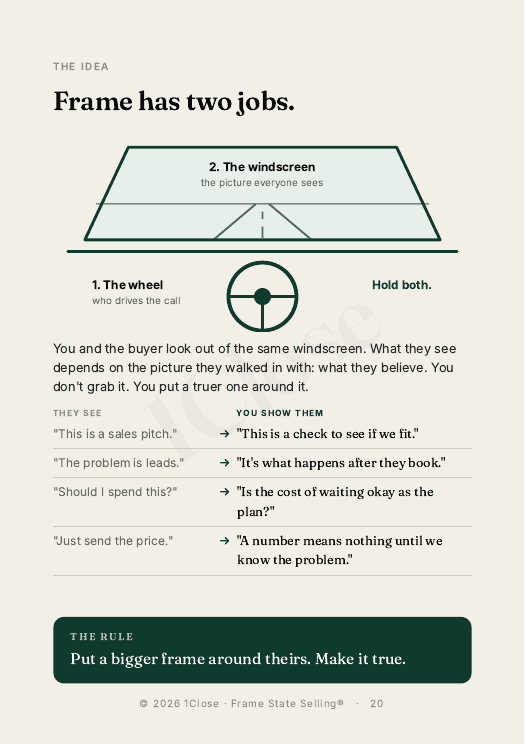
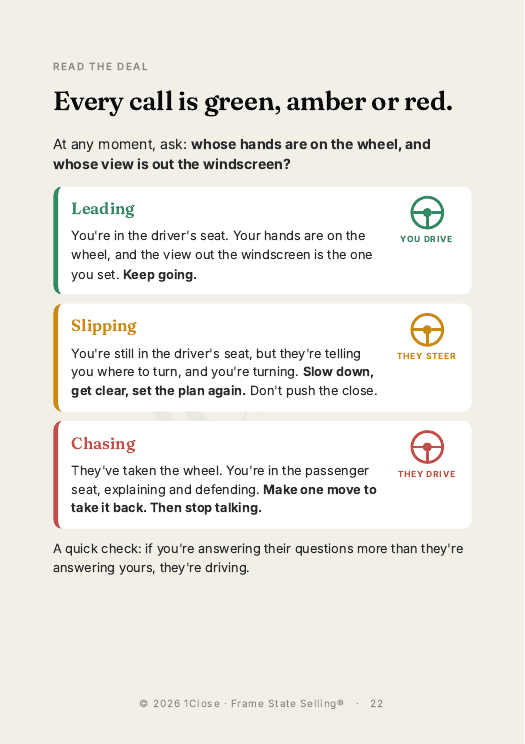
If your closer is answering their questions more than they’re answering yours, the buyer is driving. Plus the six habits that hand the buyer the wheel, every one of them audible on a call.
Closers
What to say, and when.
The plan to set in the first two minutes. How to tell which kind of no you just heard, and the loop for it. And the hardest part: what to do after you say the price. Be quiet.
Who it’s not for
Skip this book if that’s you.
- You want lines that push a buyer into a yes. The test in the book: if it only works in secret, don’t use it.
- You want a course or a certificate. It’s a book. Read it, then run it on your next call.
- You sell in one click, with no call. Everything here happens with the buyer on a call.
- You think your leads are the problem. Read it anyway. That’s the first belief it asks you to unlearn.
Inside
One idea a page. Here’s some of what you’ll find.
- Why your nicest closer may be your most expensive one
- The one question that tells you who is driving any call
- How to make urgency real without inventing a deadline
- Why 6 of 14 objections on one team’s calls could have been handled in minute two
- The four kinds of no, and why handling them all the same way is why scripts fail
- Six beliefs to unlearn, starting with “a discount gets it over the line”
- Why “I’ll follow up next week” is a slow no, and what to book instead
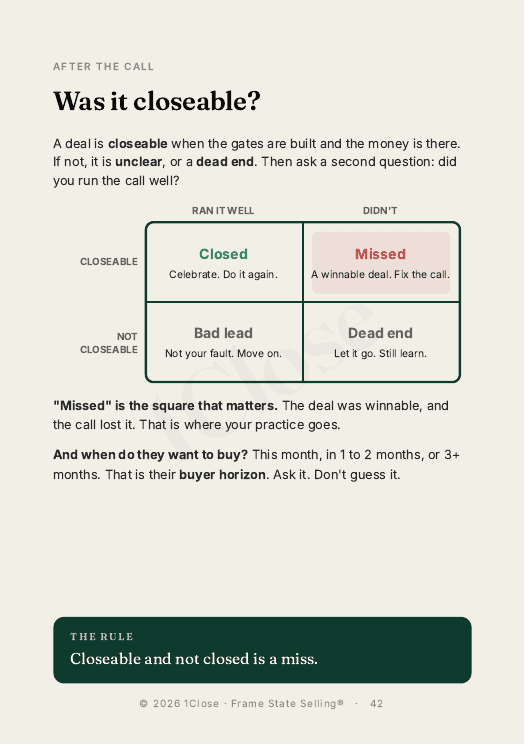
- The one number worth counting on a sales floor: calls that were closeable and didn’t close
What’s in the book
Six parts. One call, start to finish.
- 1
Who is driving?
Frame, and how to tell in any minute whether the call is green, amber or red.
- 2
Your state
Staying calm when the buyer isn’t, and why a script frees your attention.
- 3
The three gates
Pain, Doubt, Urgency: what the buyer has to say before they can say yes.
- 4
The call in seven steps
From the first two minutes to the offer, with worked pitches, including the one that sold 1Close.
- 5
When they say no
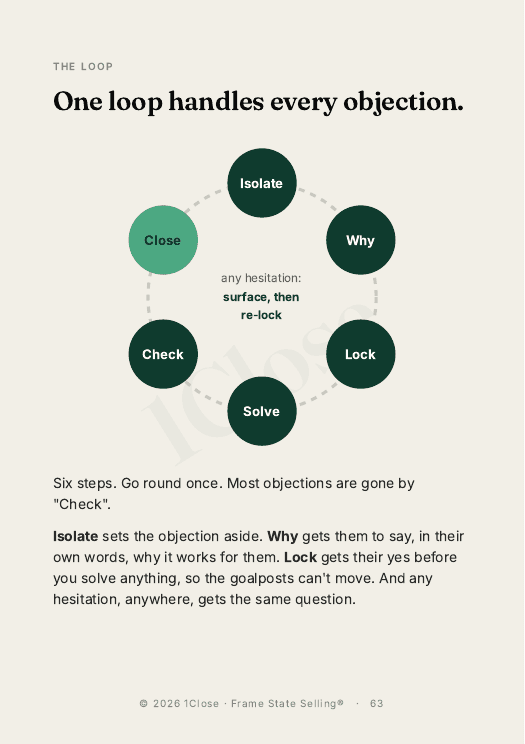
The four kinds of no, one loop for every objection, and the words for each step.
- 6
What holding frame pays
An honest call that got away, and what every gate open sounds like.
Plus: the seven objections you’ll hear most, a one-page checklist for before and after every call, and your first seven days.
The whole book on one page
Short on time? Start here.
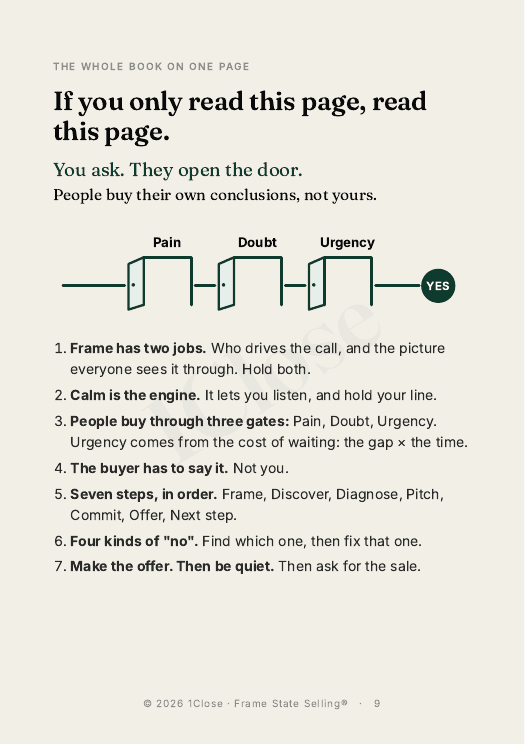
- Frame has two jobs. Who drives the call, and the picture everyone sees it through. Hold both.
- Calm is the engine. It lets you listen, and hold your line.
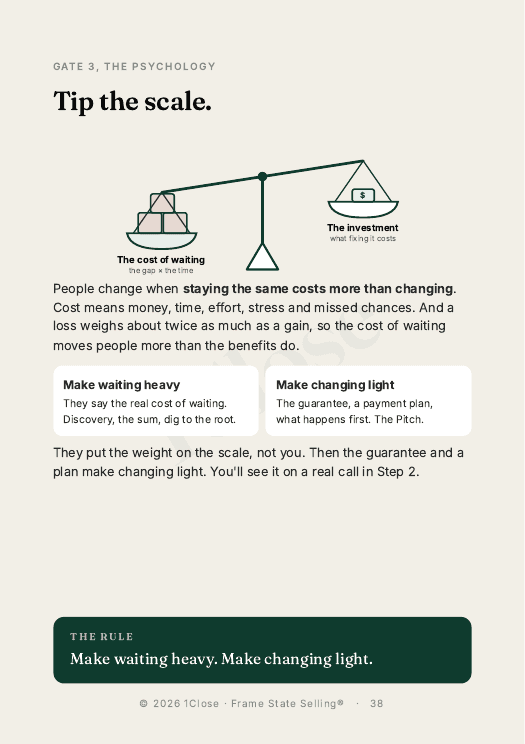
- People buy through three gates: Pain, Doubt, Urgency. Urgency comes from the cost of waiting: the gap × the time.
- The buyer has to say it. Not you.
- Seven steps, in order. Frame, Discover, Diagnose, Pitch, Commit, Offer, Next step.
- Four kinds of “no”. Find which one, then fix that one.
- Make the offer. Then be quiet. Then ask for the sale.
How the book starts
“I don’t think you guys could be more obnoxious.”
That’s how a buyer opened a call at a big trade show. George stayed calm, held the plan, and closed $9,800.
Nothing clever happened. He didn’t argue and he didn’t cave. He ran the next step. The book is that call, and thousands like it, written down so your team can run it too.

Who wrote it
I’ve been on more sales calls than I can count. So I counted.
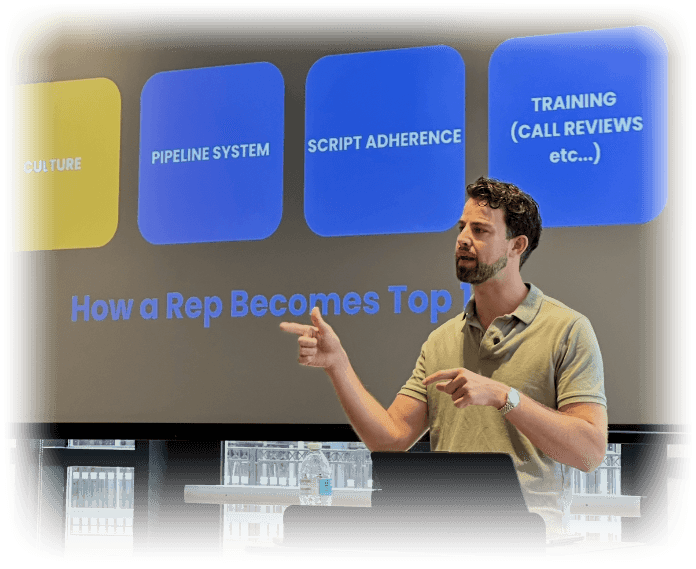
I’m George. I took the calls, ran the teams, and wrote down what kept working when the buyer pushed back. One closer I trained earned $3K, then $8K, $15K and $20K over four months, then closed $100K a month on average at a 33% close rate. This book is what I taught them, in plain words.
- high-ticket sales calls
- 5,000+high-ticket sales calls
- closed personally
- $4M+closed personally
- best month of cash collected, on a $9,800 offer
- $352,800best month of cash collected, on a $9,800 offer
- people coached one to one
- 2,500+people coached one to one
Proof
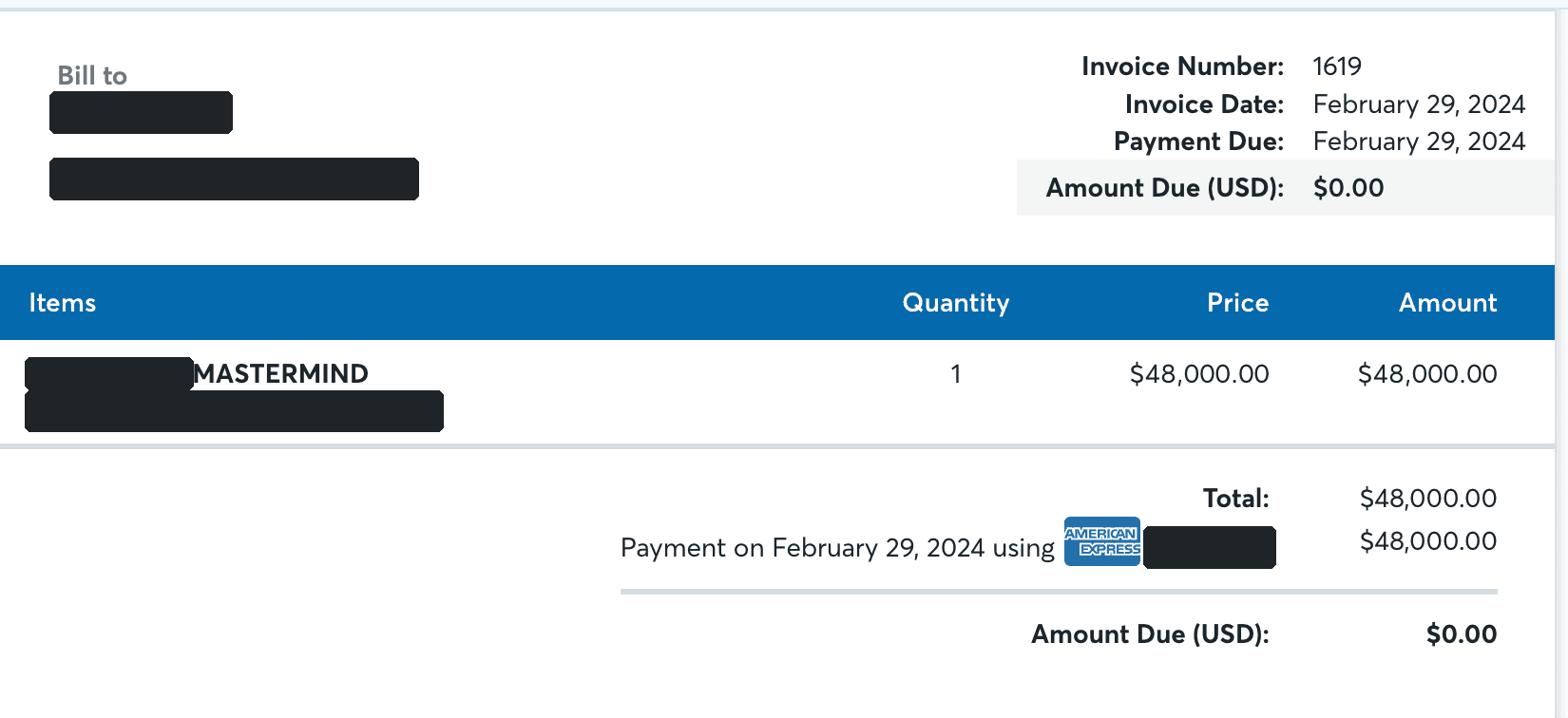
$48,000. Upfront. One payment.
One client paid for a 12 month mastermind in February 2024. Their details are redacted. “Once I closed this one, I knew anything was possible.”
Why it’s free
What’s the catch? Here it is.
I built a company called 1Close. It listens to sales calls and checks the same things this book teaches: did the closer lead, and did the buyer say it.
So the more teams that read the book, the more founders know exactly what good looks like on a call. Some of them will want to know whether their team is doing it on the calls they can’t hear. That’s the catch. If you never want that, keep the book anyway. It works on its own.
For founders running a team
This book tells you what the buyer needs to say. Running a team? You can’t be on every call to hear if they said it. 1Close is.
Questions
Before you download.
- Is it really free?
- Yes. Leave your email and the PDF lands in your inbox. Want it printed? Paperback and Kindle are on Amazon.
- Is this a course?
- No. It’s a book. There’s no programme and nothing to buy.
- We already run a method.
- Keep it. Frame State Selling® is the layer underneath MEDDIC, Sandler, NEPQ or your own script.
- Can I give it to my team?
- Please do. One script and one language is how a team starts to close the same way.
- Who is it for?
- Founders, sales managers and closers selling high ticket on calls. A new closer can follow it in an hour.
- Is it just theory?
- No. Every idea comes with the line to use on the call, and a drawing to remember it by.
Stay calm.Lead the call.Let them say it.Make the offer. Then be quiet.Hear the yes.
P.S. If you run a team, pick one recorded call from this week and run the quick check from the book: who asked more questions, your closer or the buyer? If it was the buyer, they were driving. The book shows your team how to take the wheel back. Kindly.