MEDDIC gets qualification right and closes wrong. Here's why.
MEDDIC qualifies the deal. It cannot tell you the frame slipped at 4:32. Founders who stop at the scorecard keep losing deals that were already dead.

George
8 August 2026 · 8 min read
Building the AI sales manager. Frame State Selling on every live call.
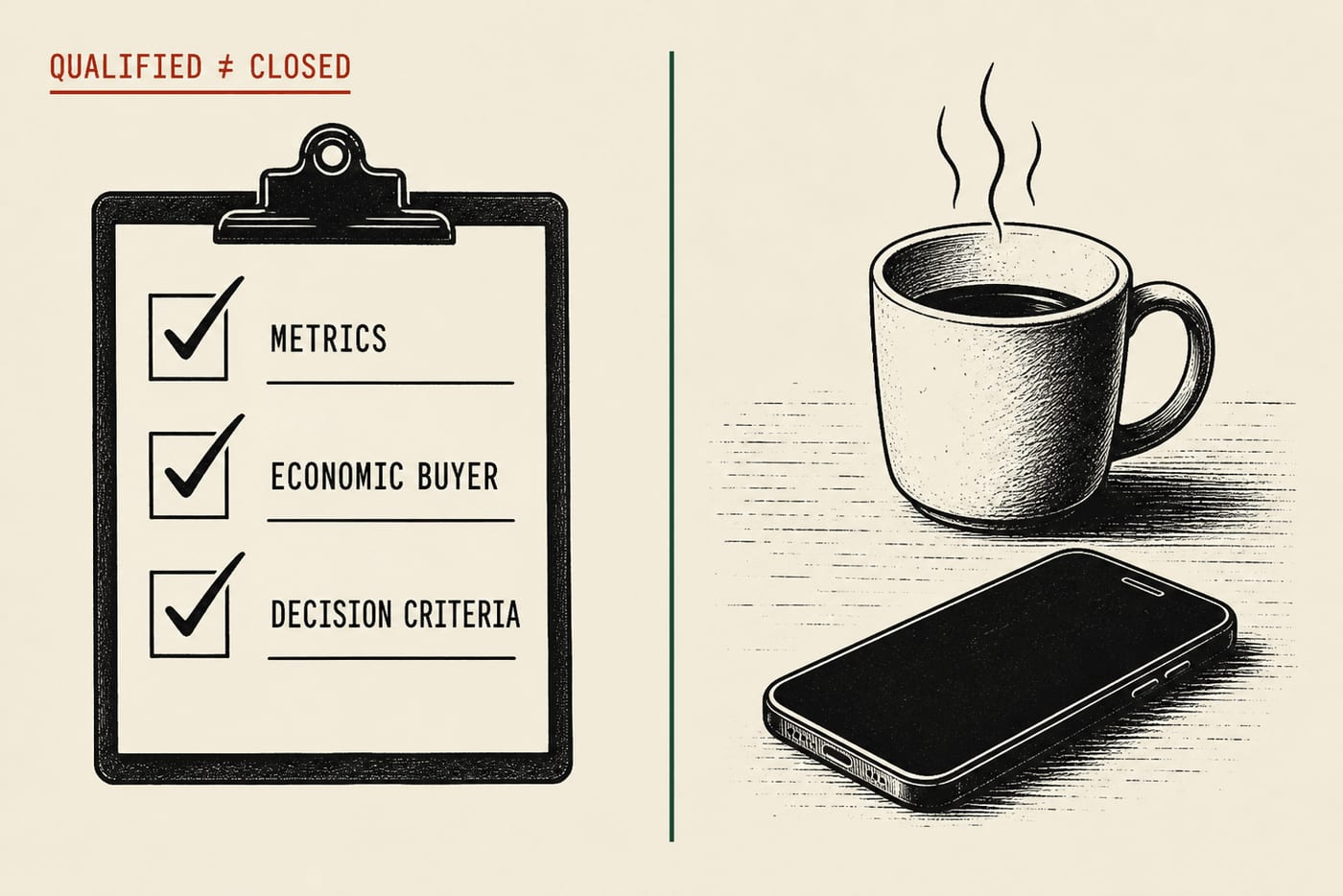
Your closer filled in every MEDDIC field. Metrics. Economic buyer. Decision criteria. Decision process. Identify pain. Champion. The CRM looks green. Forecast says close this month.
Then the prospect goes quiet. Or they ask for "one more week." Or they want to "run it past the team." You lose a deal that looked qualified.
MEDDIC did not fail at qualification. It failed at the job you actually needed: managing the live state of the deal while it was still alive.
What MEDDIC gets right
MEDDIC is good at what it was built for. It forces a closer to stop selling into fog. It asks hard questions before you waste a quarter chasing a tyre-kicker. For a founder running high-ticket deals, that discipline matters.
If your team cannot name the economic buyer, you do not have a deal. You have a conversation. MEDDIC surfaces that early. Same for decision process and real pain. On that axis, it earns its reputation.
The problem is not the checklist. The problem is what founders do with it next. They treat a filled scorecard like a managed deal. Those are not the same thing.
Qualification tells you the door is real. It does not tell you whether you still hold the room.
Where the close actually breaks
Most late-stage losses on high-ticket teams do not die from missing a MEDDIC field. They die in the middle of a call that still looked fine on paper. MEDDIC qualifies the deal. It does not manage frame state while the conversation is still warm.
- The closer answered pricing before the buyer felt the cost of waiting.
- A "think about it" landed and nobody ran a real recovery move.
- The champion went soft and the closer chased instead of re-anchoring.
- Frame slipped from Leading to Chasing in a thirty-second concession, and the CRM never noticed.
Your MEDDIC sheet still says champion identified. Your pipeline still says Commit. Your gut already knows the deal cooled.
Gong can show you talk ratio. Sybill can summarise the meeting. Neither of them tells you which state the deal is in now, or what move restores it. That is management work. A qualification framework was never designed to do it.
The scene that looks fine and is already dead
Picture a Thursday discovery call. Your closer has Metrics from the setter notes. Economic buyer confirmed for next week. Pain is clear. Champion is warm.
At minute twelve the buyer asks, lightly, what investment looks like. Your closer answers. Not badly. Just early. The room cools half a degree. The buyer starts asking process questions instead of problem questions. Your closer answers those too. Helpful. Compliant posture. Chasing frame.
By the end, everyone agrees the next step is "send something over." MEDDIC still looks complete. The deal is already Slipping: the buyer is setting terms and your closer is following. Nobody on your team has a system that says that out loud before Monday's forecast meeting.
That is the gap. Not knowledge. Not effort. Not "better discovery training." Presence on the deal while the state is changing.
The Sunday night tell
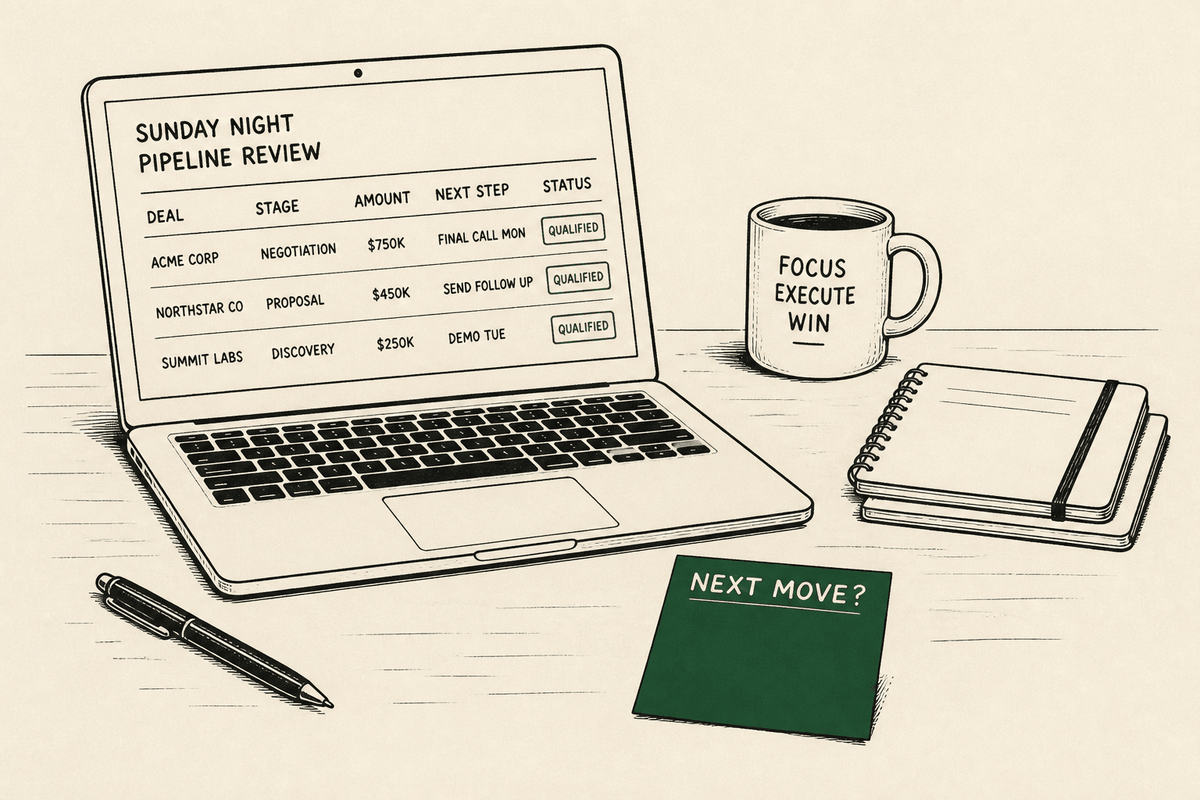
Sunday night pipeline review. Three deals marked qualified. Nobody can name the next move.
You have felt this as a founder. Sunday night. Pipeline review. Three "qualified" deals that should have closed. You open the notes. Everything looks complete. Metrics. Buyer. Process. Pain.
Then you ask the only question that matters: what is the next move on each one, and why that move?
Silence. Or a vague "following up Tuesday." Or a promise to "nudge the champion." Nobody can say whether the frame is Leading, Slipping, or Chasing. Nobody can point to the belief that stalled. Nobody remembers what was promised three calls ago without digging through Slack.
That is not a closer talent problem. That is an uninstalled manager function. MEDDIC filled the form. Nobody managed the deal.
Why another methodology binder will not fix this
Another binder will not fix this because methodologies leak under pressure. Your closer knows MEDDIC. They forget it when the buyer grabs the frame. A binder cannot sit on the call. A dashboard cannot tell them the move. A human manager who reviews one call a week cannot scale past three reps without becoming the bottleneck you already are.
The reflex is to layer more training anyway. SPIN refreshers. Challenger workshops. Sandler drills. Another certification. Another Monday morning "let's get tighter on discovery."
I have watched this pattern for years. At EmailMarketing.com I scaled monthly revenue from $180K to $437K/month in 8 months with the same two closers, by installing the manager function so the methodology showed up on the call, not just in the onboarding deck. That is also why losing the best closer breaks so many teams. The methodology walked out with them.
Frame State Selling™ is the layer underneath the scorecard. It watches the relational state of the deal: who is setting the terms, which belief is missing, which resistance type just landed. The Frame Intelligence Engine® is what runs that judgment on every sales call so your team never starts from zero.
MEDDIC can still live in your process. You keep your method. Frame State Selling is the layer underneath. The Frame Intelligence Engine is what runs on your calls.
What you should be reading instead of a green CRM row
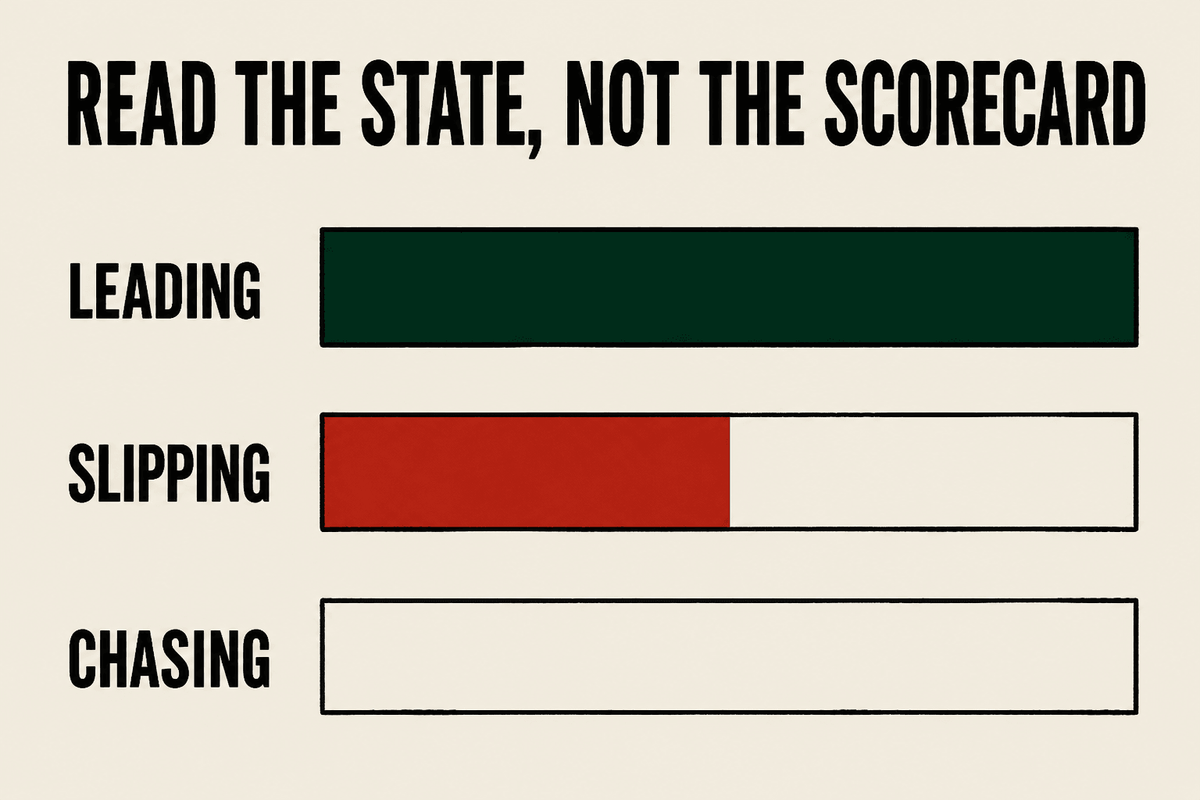
Frame states Leading, Slipping, and Chasing. Read the state, not the scorecard.
Scorecard
Filled MEDDIC row. Green CRM field. No live signal.
State
Leading, Slipping, or Chasing. Read once per call minute.
Move
From this deal's memory, in the buyer's own words.
When a deal is alive, the founder question is not "is it qualified?" It is:
- What is the frame state right now? Leading, Slipping, or Chasing.
- Which gating belief is incomplete? Problem Reality, Self-Solve Collapse, or Cost of Inaction.
- What resistance just showed up? Obstacle, Objection, Frame Grab, or Pushback. Each needs a different move.
- Is the decision environment blocked? Stakeholders, timing, means. Map it. Logistics to qualify, not a belief to build.
- What is the next move, in the buyer's words, from this deal's memory? Not a generic template.
That is the difference between a scorecard and a sales manager. One audits eligibility. The other manages the close while the conversation is still warm.
| Founder question | MEDDIC scorecard | Sales manager function |
|---|---|---|
| Is this a real deal? | Qualifies eligibility | Same |
| Who holds the frame right now? | Not its job | Leading, Slipping, or Chasing |
| What move comes next? | Not its job | From deal memory and frame state |
| Why did a qualified deal go quiet? | Cannot say | Points to the belief or frame slip |
If your team can fill MEDDIC and still lose "should-have-closed" deals every quarter, you do not need a stricter CRM ritual. You need the manager function installed on every deal.
What this looks like when it is installed
When the manager function is installed, the founder read of the pipeline changes shape.
You are not scrolling green CRM fields hoping they mean something. You are reading which deals need attention this week, and the move each one needs. Your closer who fumbled the money objection on Tuesday gets a drill built from that buyer's words before Thursday. The follow-up is drafted from the frame state the call ended in. You approve it. The team never starts from zero on Monday because deal memory kept the thread.
That is not "AI that writes emails." That is the sales manager job, productised: computed frame state, durable deal memory, methodology installed into the team.
The install, not the lecture
Stop hiring another person to babysit the same scorecard. Stop buying another observation tool that tells you what already happened. Install something that remembers the state of every deal, scores the sales call against frame, and tells each closer the move before Thursday's follow-up.
That is what an AI sales manager is for. Not CRM busywork. Not talk-ratio theatre. Computed frame state, deal memory that never starts from zero, and methodology installed into the team so it compounds instead of walking out with your best closer.
MEDDIC will keep getting qualification right. Closing still needs a manager on the deal.
If that is the gap on your team, book a demo. Bring one "qualified" deal that went quiet. We will show you the state it was actually in, and the move it needed.
Written by
George
Founder, 1Close
Building the AI sales manager. Frame State Selling on every live call.
Building the AI sales manager. Writes about high-ticket closing, frame, and how founder-led sales teams actually scale.
Frame State Selling® · Frame Intelligence Engine®
Keep reading
The deal didn't stall. You lost the frame.
"Let me think about it" is rarely about thinking. It's the sound of a frame you stopped holding three questions ago. Here's how to spot the handover and take it back.
12 June 2026 · 3 min read
One un-recovered deal per quarter is next year's sales manager
One should-have-closed deal per closer per quarter is the real cost of losing sales deals nobody totals. Bigger than the sales manager you keep parking.
10 August 2026 · 8 min read