The 7 best sales methodologies, and where every one breaks.
From 35,000 recorded calls to the Wolf of Wall Street. SPIN, Challenger, Sandler, MEDDIC, Gap Selling, NEPQ and Straight Line: where each came from, what it gets right, and the layer underneath all seven.
What your method covers
7 methods
What to say
1 layer
Whose terms you say it on
Your closer knows one by heart. So why did they still lose the deal?

George
28 September 2026 · 27 min read
Building the AI sales manager. Frame State Selling on every live call.
Your closer knows the method by heart. They passed the training. They can recite the questions in order.
At minute fourteen the buyer says, "Can you just send me the pricing? I'll look at it tonight."
Your closer says, "Sure, no problem."
Nobody on that call did anything wrong by the book. The questions were fine. The pricing was fine. And the deal is already gone, because the buyer just took over the call and your closer let them.
I've spent months taking the best sales methods on the planet apart. I read the books, went back to the original research where it exists, and checked the numbers everyone quotes. Some of them are wrong. This post covers all seven: what each one gets right, where each one breaks, and the one layer none of them teach.
How I judged them
Four questions, asked of every method:
- What does it see? The questions, the deal, the buyer's head, or the room.
- What does it build in the buyer? Every sale needs the buyer to believe some things before they can say yes. Which ones does it cover?
- What happens under pressure? The buyer pushes back, grabs the call, goes quiet. Does the method still hold?
- Does the yes last? A yes that turns into a refund, a chargeback or a ghost is not a close.
I also say what kind of sale each one fits. A method built for a nine-month enterprise deal is a bad fit for a one-call close on Zoom, and the other way round.
1. SPIN Selling
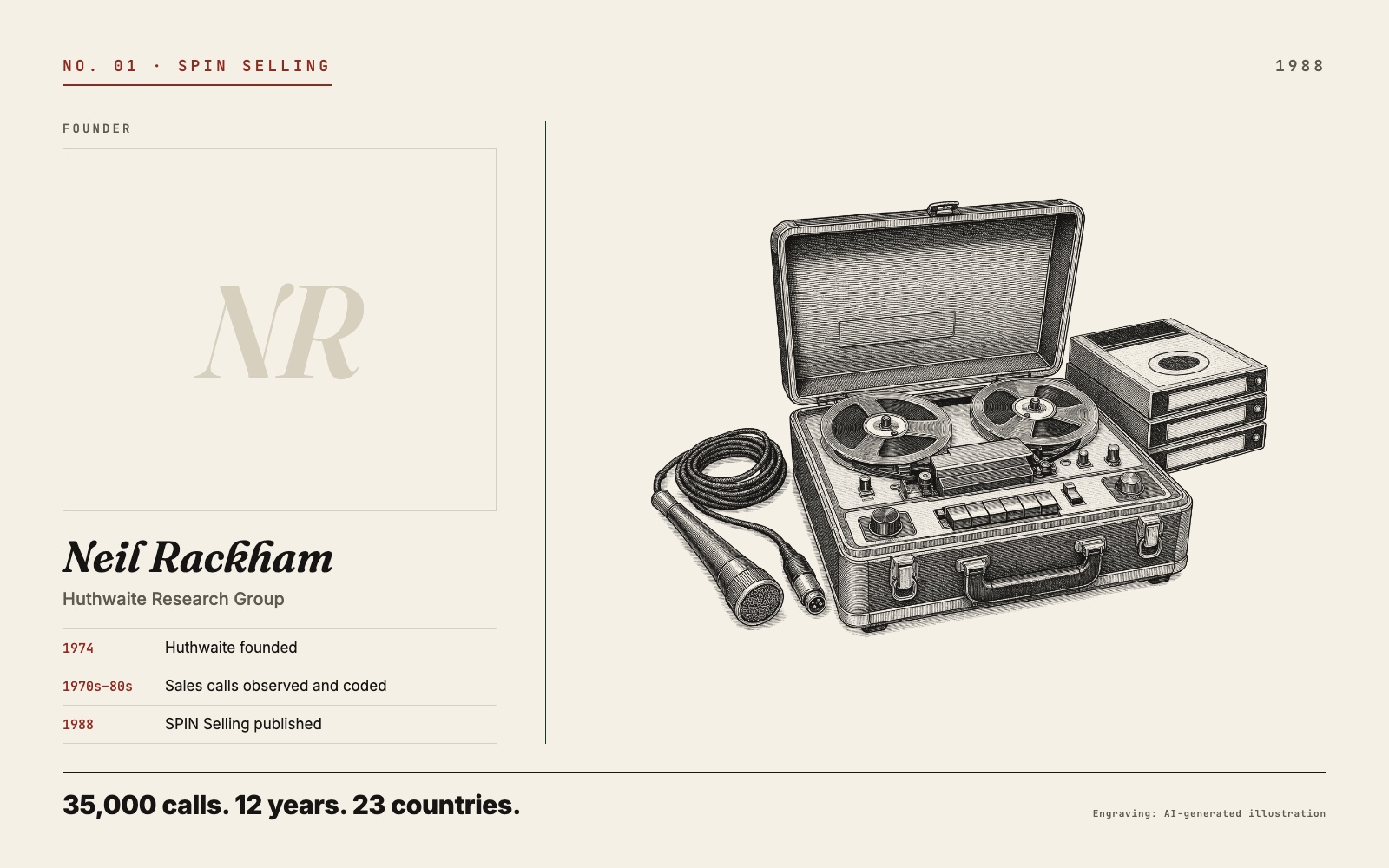
No. 01. SPIN started as recorded calls, not a theory. Engraving: AI-generated illustration.
The history. Neil Rackham's Huthwaite Research Group was founded in 1974 to answer one question: what do the best sellers actually do differently in big sales? Instead of asking them, the team watched and coded real sales calls for 12 years. The findings became SPIN Selling in 1988. Nearly forty years on, it's still the most researched method in sales.
SPIN is the one with the research. Rackham's team studied more than 35,000 sales calls made by 10,000 salespeople in 23 countries over 12 years. Almost nothing else in sales training can say that.
The finding: in bigger sales, the best sellers ask four kinds of question. Situation (the facts), Problem (what's wrong), Implication (what that problem is causing) and Need-payoff (what fixing it would be worth). Huthwaite calls them a logical framework, not a rigid sequence.
What it gets right. Implication questions are the best tool ever written for letting a buyer feel the cost of a problem in their own words. The buyer tells you what it's costing them. You don't tell them.
Where it breaks. SPIN tells you which question to ask. It says nothing about what happens when the buyer refuses to answer it. "Can we skip all this?" isn't a SPIN problem, and there's no SPIN answer to it.
There's a line from Rackham himself that every sales leader should read. Looking back on why trained reps sold 17% more than control groups, he said: "it wasn't the four little questions. It was the whole coaching process."
The man who wrote the most researched method in sales says the method was the smaller part. The coaching was the bigger part.
Best for: large, multi-call B2B sales. It was built there.
2. The Challenger Sale
No. 02. Challenger turned "teach the buyer something" into a method. Engraving: AI-generated illustration.
The history. Matthew Dixon and Brent Adamson ran the study at CEB, a research company Gartner later bought. They published it as The Challenger Sale in 2011. A year later they took it further in Harvard Business Review, in a piece called "The End of Solution Sales". The argument: buyers now get nearly 60% of the way through a decision before they talk to a supplier, so the rep who waits to be told the problem has already lost.
CEB surveyed more than 6,000 reps from 83 companies and sorted them into five types: Relationship Builder, Reactive Problem Solver, Hard Worker, Lone Wolf and Challenger. Challengers made up nearly 40% of the star performers (the top 20% on quota). Relationship Builders made up 7%.
The method is Teach, Tailor, Take Control. You bring the buyer an insight about their business they didn't have, you tailor it to each person in the room, and you're willing to push back instead of caving.
What it gets right. Two things. It killed the idea that being liked closes deals. And it names taking control as a skill. That's the closest any mainstream method gets to frame.
Where it breaks. "Take control" is the least taught of the three. The books go deep on commercial teaching and much lighter on what to do when the buyer takes control back. And teaching has a failure mode: a rep who's taught at a buyer can make them defensive instead of curious. An insight the buyer finds for themselves sticks. An insight you hand them is something they have to defend.
The research is also worth reading with care. Managers rated their own reps, so it shows what star reps look like, not what causes a star. And the numbers get misquoted a lot. It's 83 companies, not 90 or 100.
Best for: complex enterprise B2B with buying groups. Poor fit for a one-call close.
3. Sandler
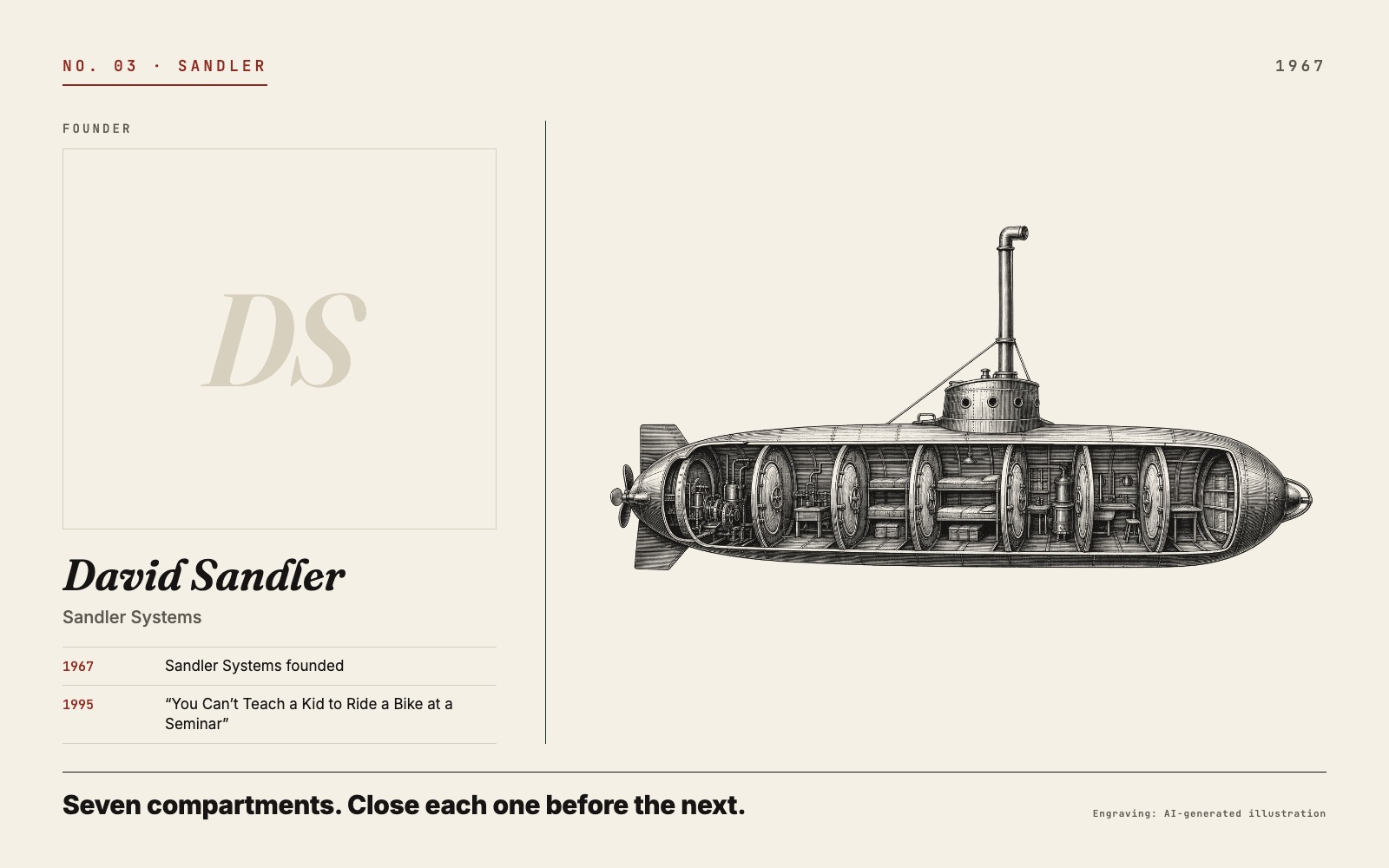
No. 03. The submarine is Sandler's own picture of the method: seven compartments, each sealed before you move on. Engraving: AI-generated illustration.
The history. David Sandler founded Sandler Systems in 1967, which makes it the oldest method on this list. It found its home with people who sell their own business: owners, and small teams without a big sales department. His book You Can't Teach a Kid to Ride a Bike at a Seminar came out in 1995, the year he died. The company still trains under his name today.
Sandler starts from one line: people love to buy but hate to be sold. The system is the "submarine", seven compartments you close one at a time: Bonding & Rapport, Up-Front Contracts, Pain, Budget, Decision, Fulfillment, Post-Sell.
What it gets right. The up-front contract is one of the best ideas in sales. You agree at the start what the call is for and what happens at the end, including that "no" is a fine answer. Sandler also teaches the seller to be willing to walk away. That's a real posture, and most methods skip it.
Where it breaks. The submarine is a strong sequence, and sequences are exactly what buyers try to skip. Sandler has an answer for that (go back to the contract), but some of its moves, like negative reverse selling, can tip into games. The buyer feels played, and a buyer who feels played stops telling you the truth.
Best for: SMB and mid-market B2B, and owner-led selling.
4. MEDDIC and MEDDPICC
No. 04. MEDDIC came out of an engineering-software company, and it shows: it measures the deal. Engraving: AI-generated illustration.
The history. PTC made engineering software, and in the mid-1990s it was growing fast. In 1996 Dick Dunkel, working with Jack Napoli under sales leader John McMahon, wrote down what separated the deals that closed from the ones that only looked good in the forecast. PTC's sales leaders took it with them to other software companies, and two former PTC leaders founded Force Management in 2003 to teach it. That's how six letters became the standard in enterprise software.
Strictly, MEDDIC isn't a way to sell. It's a qualification framework: a list of what you must know about a deal, not how to run the call that finds it out. It's on this list because most teams run it as if it were their sales method.
MEDDIC was built at PTC to stop enterprise reps forecasting deals that were never real: Metrics, Economic buyer, Decision criteria, Decision process, Identify pain, Champion. MEDDPICC adds Paper process and Competition.
What it gets right. Discipline. If your closer can't name who signs, there's no deal. There's a conversation. MEDDIC finds that out early and makes the forecast honest.
Where it breaks. MEDDIC is a checklist, not a way to run a call. It tells you what you should know by the end of the deal. It doesn't tell you how to get the buyer to tell you, or what to do when they won't. I wrote a whole post on this: MEDDIC gets qualification right and closes wrong. Every box can be ticked on a deal that already went cold.
Best for: enterprise, long cycles, many stakeholders. Close to useless for a one-call close.
What 1Close shows instead. 1Close reads the same ground on every scored call. The difference is where it comes from: what the buyer actually said, not what your closer typed into the CRM afterwards. Every deal gets one verdict:
Closeable
The core beliefs have landed. Push for a decision now.
Unclear
Gates still open. More diagnosis before you push the close.
Dead end
Not qualified on beliefs or fit. Exit clean.
Underneath the verdict, the same questions MEDDIC asks:
| MEDDIC asks | What 1Close shows |
|---|---|
| Identify pain | Pain. Has the buyer said, in their own words, that they have a problem worth solving? |
| Metrics | Cost of waiting. What staying the same is costing them: a number, a situation or a trend. |
| Economic buyer, Champion | Decision environment. Whose backing this decision needs, and whether they're in the room. |
| Decision process, Paper process | Decision environment. Whether the process and the timing will allow a yes. |
| Decision criteria | Solution. Does the buyer believe this fixes their problem? |
| (not in MEDDIC) | Money. Is the money there, and is it free for this, now? |
A MEDDIC box turns green when your closer believes it. A 1Close read turns green when the buyer said it, with the quote to prove it. One honest gap: MEDDPICC's Competition letter tracks rival vendors, and 1Close doesn't track those on the call today.
5. Gap Selling
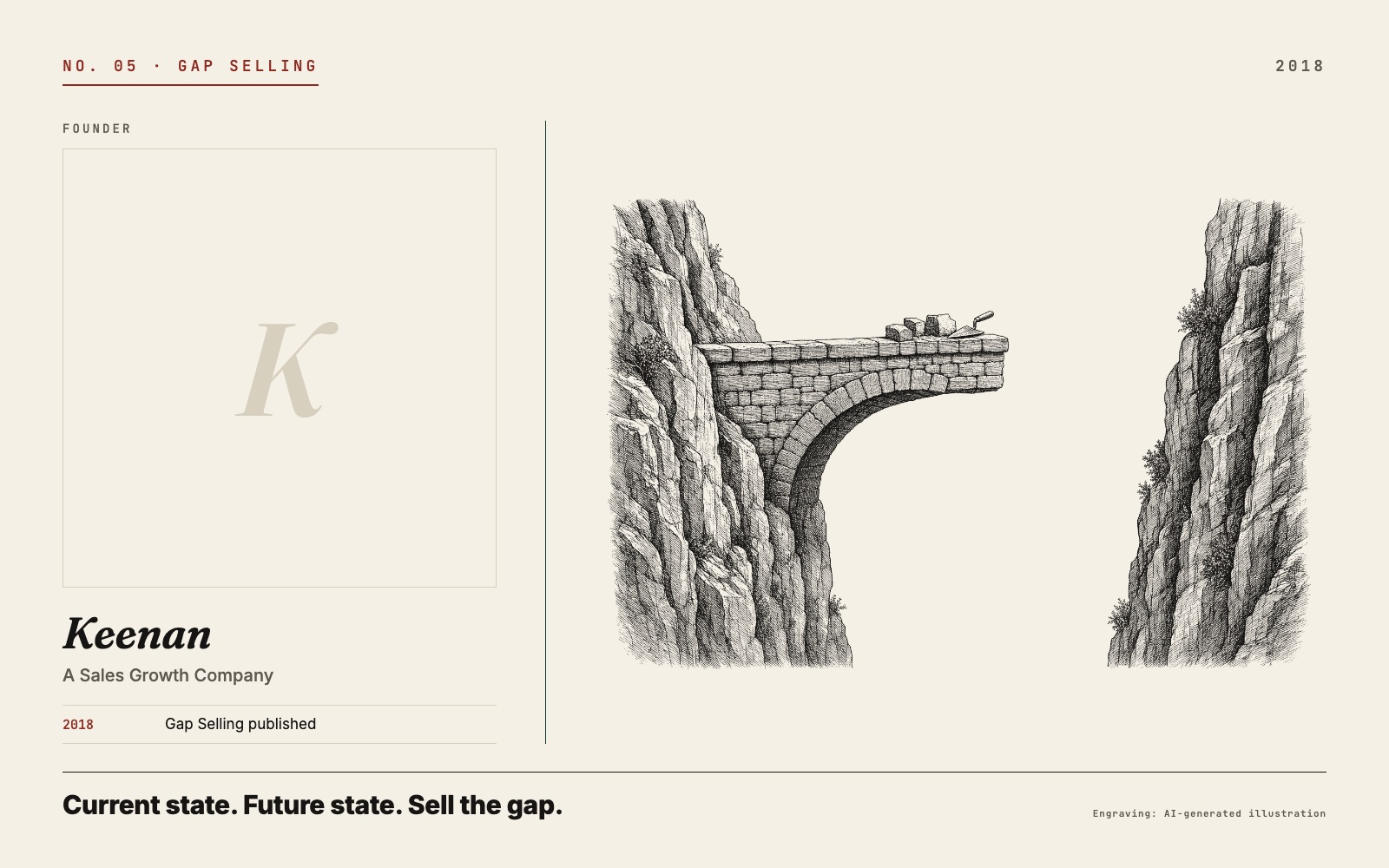
No. 05. The gap between where the buyer is and where they want to be. Engraving: AI-generated illustration.
The history. Keenan, who goes by his surname and runs the consultancy A Sales Growth Company, published Gap Selling in 2018. It was written as an argument against relationship selling. His point is that buyers don't buy because they like you. They buy change, so the job is to find the problem and size it, not to be liked.
Gap Selling says the buyer isn't buying your product. They're buying the move from where they are (the Current State) to where they want to be (the Future State). The size of that gap is the value. You map the problem, what it's doing to them and the root cause, then sell across the gap.
What it gets right. It keeps the call on the buyer's problem instead of your product. The gap is the cleanest picture of what a sale is. We agree with it so much that it's built into Frame State Selling: "I have a problem. It's costing me this. We want to be there."
Where it breaks. Run badly, gap work turns into an audit. "Walk me through your process. Quantify that. Now quantify that." The buyer answers every question and feels interrogated the whole way. Same skeleton, wrong feel. Gap Selling also has no research base behind it the way SPIN does. It's a strong practitioner framework, and that's what it claims to be.
Best for: B2B, from SaaS to mid-market.
6. NEPQ
No. 06. NEPQ's promise is that the buyer turns the key themselves. Engraving: AI-generated illustration.
The history. Jeremy Miner built NEPQ and teaches it through his company, 7th Level. Unlike the older methods on this list, it grew up online, through video and social media rather than corporate training rooms. It spread fastest among closers selling high-ticket offers over the phone and Zoom, which is exactly who it was built for.
NEPQ stands for Neuro-Emotional Persuasion Questioning. The idea: pressure creates resistance, so don't push. Ask questions that let the buyer persuade themselves. The stages usually run Connecting, Situation, Problem Awareness, Solution Awareness, Consequence, Commitment.
What it gets right. A lot. The buyer persuading themselves is the right idea. The low-pressure tone is right. NEPQ is very popular with high-ticket closers for good reason: it works better than the hard-close scripts it replaced.
Where it breaks. Two places.
The name says "neuro", but the method page cites no neuroscience. That doesn't make the questions bad. It does mean the "science" is branding.
The bigger problem is the Consequence stage. Letting the buyer feel the real cost of their problem is legitimate. The line gets crossed when the closer starts supplying the fear: painting the scene, turning up the emotion, pushing for urgency before the buyer has seen any proof. A decision made at that emotional peak often doesn't survive the next morning. That shows up later as a refund, a chargeback, or "I've changed my mind." The yes counted on the day. It didn't last.
Best for: high-ticket B2C and small-business sales by phone or Zoom, often closed in one or two calls. The world most of our customers sell in.
7. Straight Line Persuasion
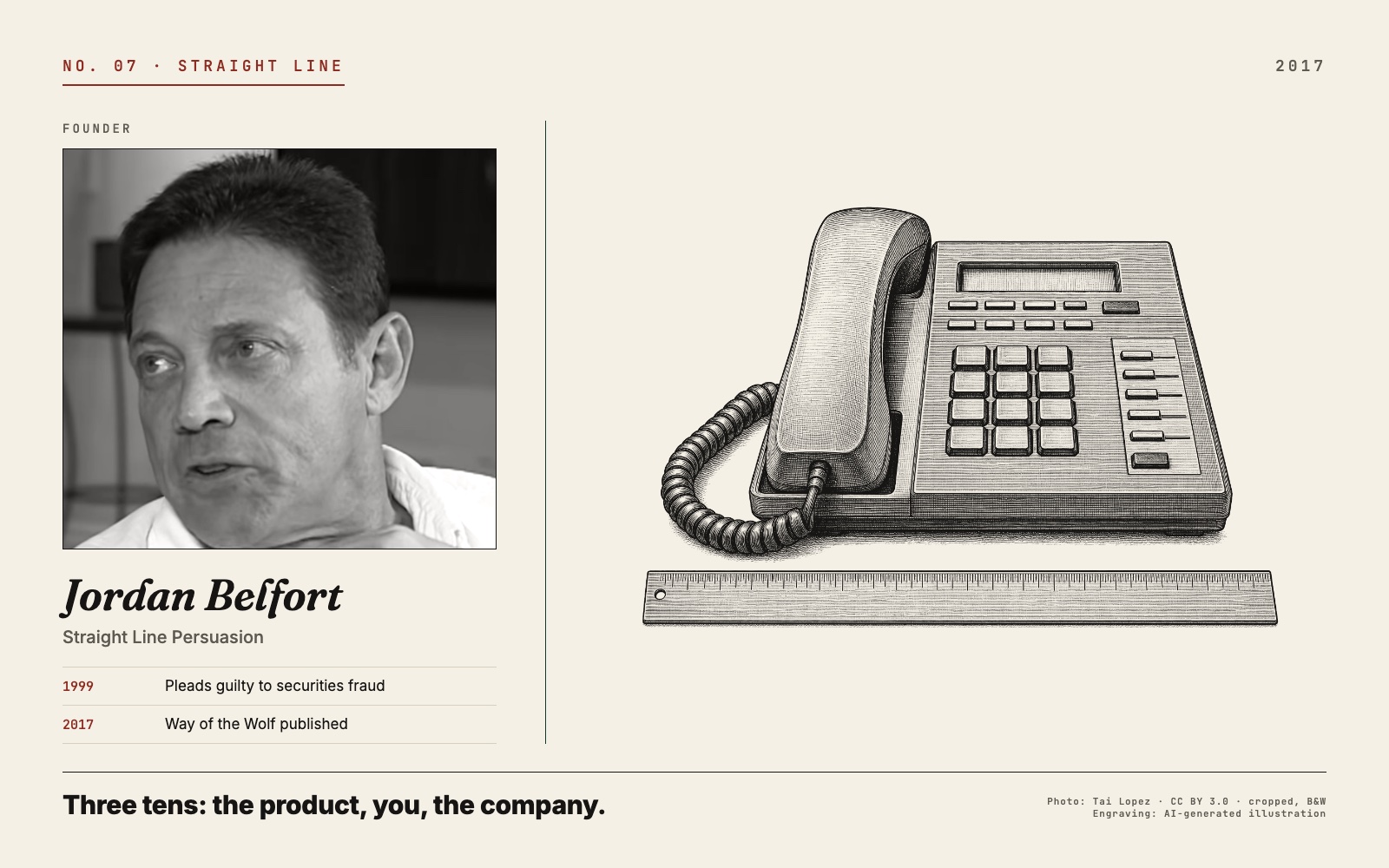
No. 07. Photo of Jordan Belfort: Tai Lopez, CC BY 3.0, cropped and converted to black and white. Engraving: AI-generated illustration.
The history. Jordan Belfort built the Straight Line in the phone room at Stratton Oakmont, the brokerage he founded in 1989. Regulators shut it down in 1996, and the story later became the film The Wolf of Wall Street. After prison, Belfort rebuilt the system as a training programme and published it as Way of the Wolf in 2017. It's the only method here whose history is also a warning.
The Straight Line says every sale is a line from open to close, and your job is to keep the buyer on it. At its centre are the Three Tens: the buyer has to be at ten out of ten certainty on the product, on you and on your company before they'll buy. Anything less and they need a push past their "action threshold".
What it gets right. One thing, and it's a big one. Belfort names certainty as the thing the buyer needs to buy. He's right. Almost no other method says it so plainly. A buyer doesn't say yes because they were asked the right questions. They say yes when enough of the right things feel true.
Where it breaks. It treats certainty as something the closer transfers into the buyer by force of conviction and tone. That works on the day. It is also how boiler rooms work. The yes is borrowed from the closer's certainty, and when the closer leaves the room, the certainty leaves with them. It's worth being plain about where the method comes from: Belfort pleaded guilty to securities fraud in 1999, and investors lost around $200 million.
Best for: one-call phone closes and transactional high-ticket sales.
The two everyone asks about: Klaff and Voss
They're not full sales methods, but they come up on every call about this, so here's the short version.
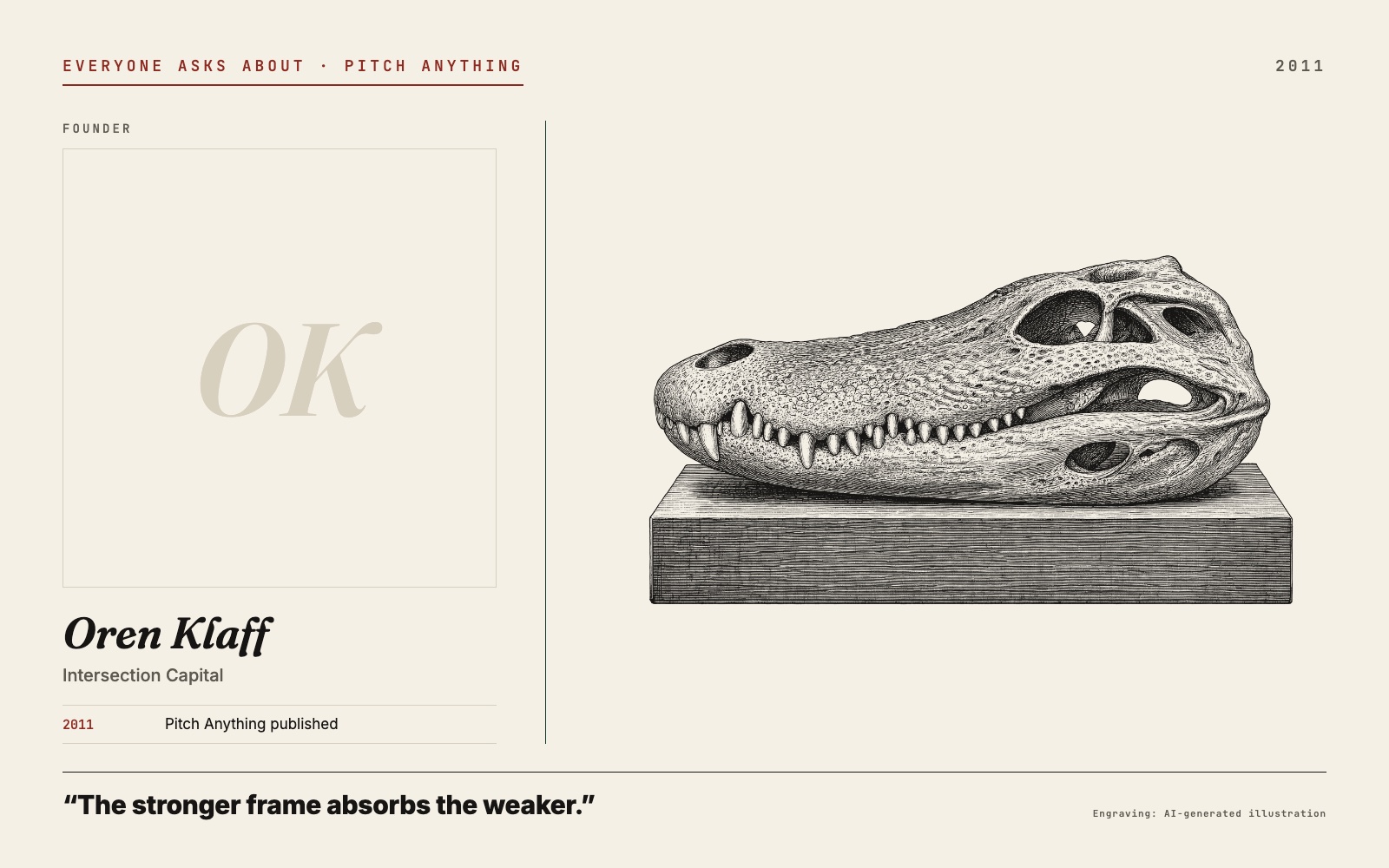
The "croc brain", drawn as what it is: a museum specimen. Engraving: AI-generated illustration.
Oren Klaff, Pitch Anything (2011). Klaff raised money for a living, as Director of Capital Markets at Intersection Capital, and says his method raised more than $400 million. If you've heard "frame" in sales, you probably heard it from Klaff. His line: "They collide, and the stronger frame absorbs the weaker." He names the buyer's power frame, time frame and analyst frame, and gives you counters like the prize frame (you're the prize, not them).
He's right that frames collide and one wins. He's wrong about why. Klaff explains it with the "croc brain", the old idea that a reptile brain inside your head filters every pitch. That idea has long been discredited among neurobiologists. And because he frames it as a fight for power and status, a lot of people who read Klaff come out louder, not steadier. Loud is not frame. Loud is usually a sign someone's afraid of losing it.
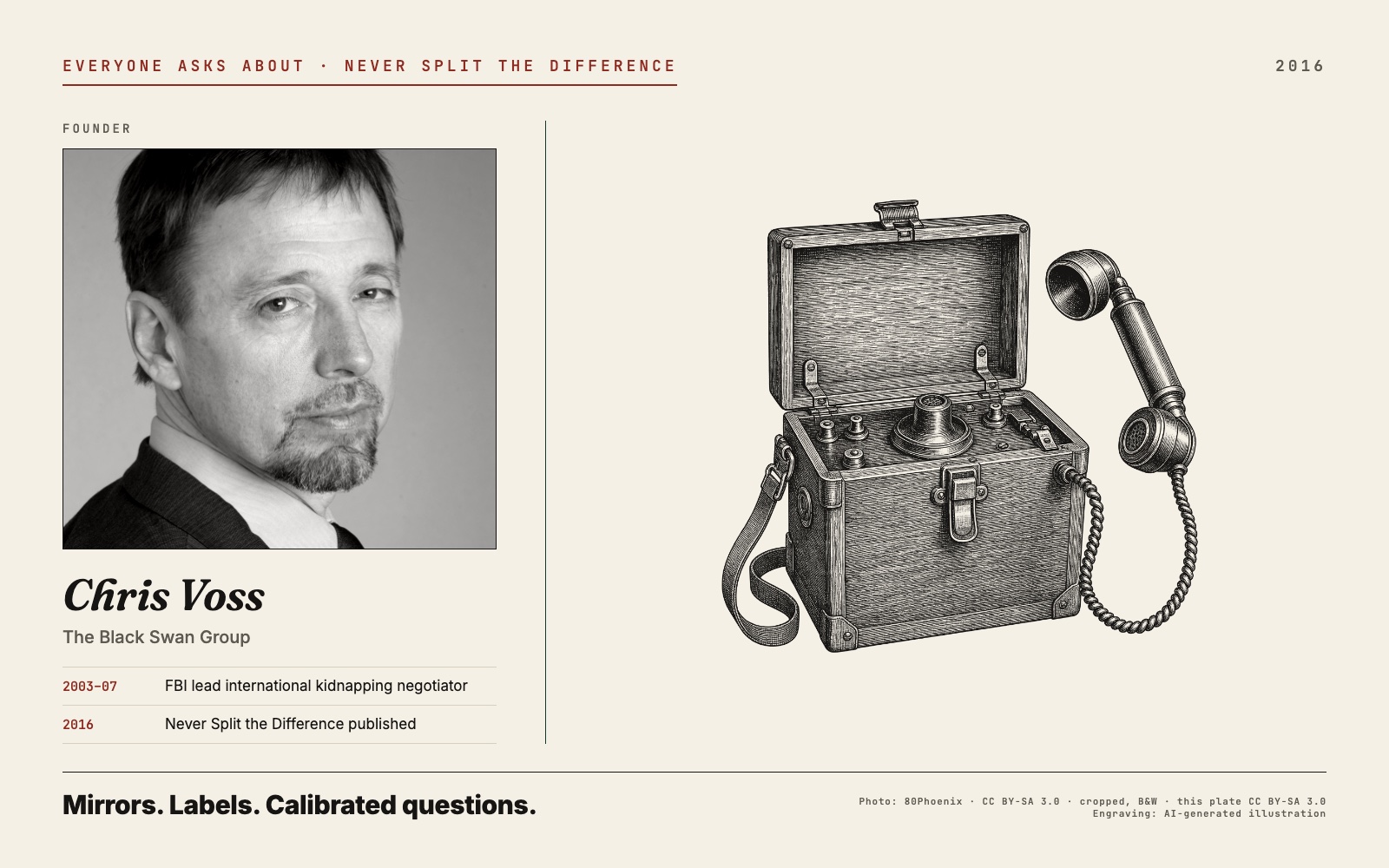
Photo of Chris Voss: 80Phoenix, CC BY-SA 3.0, cropped and converted to black and white. This plate is released under the same licence. Engraving: AI-generated illustration.
Chris Voss, Never Split the Difference (2016). Voss spent 24 years at the FBI and was its lead international kidnapping negotiator from 2003 to 2007. He left, founded The Black Swan Group, and wrote the book with Tahl Raz. His tools are the best in print for tense moments: mirrors (repeat their last few words), labels ("It sounds like…"), calibrated "what" and "how" questions, and listening for "that's right", which means the buyer feels understood. Use all of them. But Voss is a negotiation toolkit, not a way to run a sales call from start to finish. It covers the hard minutes. It doesn't cover the whole call.
Seven methods, one gap
Put them side by side and a pattern shows up.
| Method | What it sees best | Where it breaks | Best for |
|---|---|---|---|
| SPIN | The questions | When the buyer won't answer them | Large multi-call B2B |
| Challenger | The insight | When the buyer takes control back | Enterprise buying groups |
| Sandler | The sequence | When the buyer skips the sequence | SMB and owner-led B2B |
| MEDDIC | The deal on paper | During the call itself | Enterprise forecasting |
| Gap Selling | The problem | When it turns into an audit | SaaS and mid-market B2B |
| NEPQ | The buyer's emotions | When the closer supplies the fear | High-ticket, one or two calls |
| Straight Line | The buyer's certainty | When the certainty was borrowed | One-call phone closes |
Every one of them is about what to say. None of them trains whose terms the call is running on when you say it.
That's why your closer can know a method perfectly and still lose the deal at minute fourteen. The method was in their head. The call was running on the buyer's terms. Same script, but on whose terms? When the closer is steady and leading, the questions work. When the closer is following, the same questions sound like pleading.
That missing layer has a name.
Frame State Selling, in plain words
The layer underneath. Holding frame is being the steadiest thing in the room. Engraving: AI-generated illustration.
Frame State Selling® is the layer underneath your method. It isn't a script. It's a way of reading what's happening on a call, and on a deal, while it's happening. Here's all of it.
Frame: who's setting the terms
Frame is who sets the pace, the process and the next step. That's it.
At any point in a call or a deal, frame is in one of three states:
Leading
You set the sequence and the next step. The buyer is following a process you named.
Slipping
Control is unclear. The buyer has started setting some of the terms.
Chasing
The buyer sets the timeline and you react. You're following up, they're deciding when.
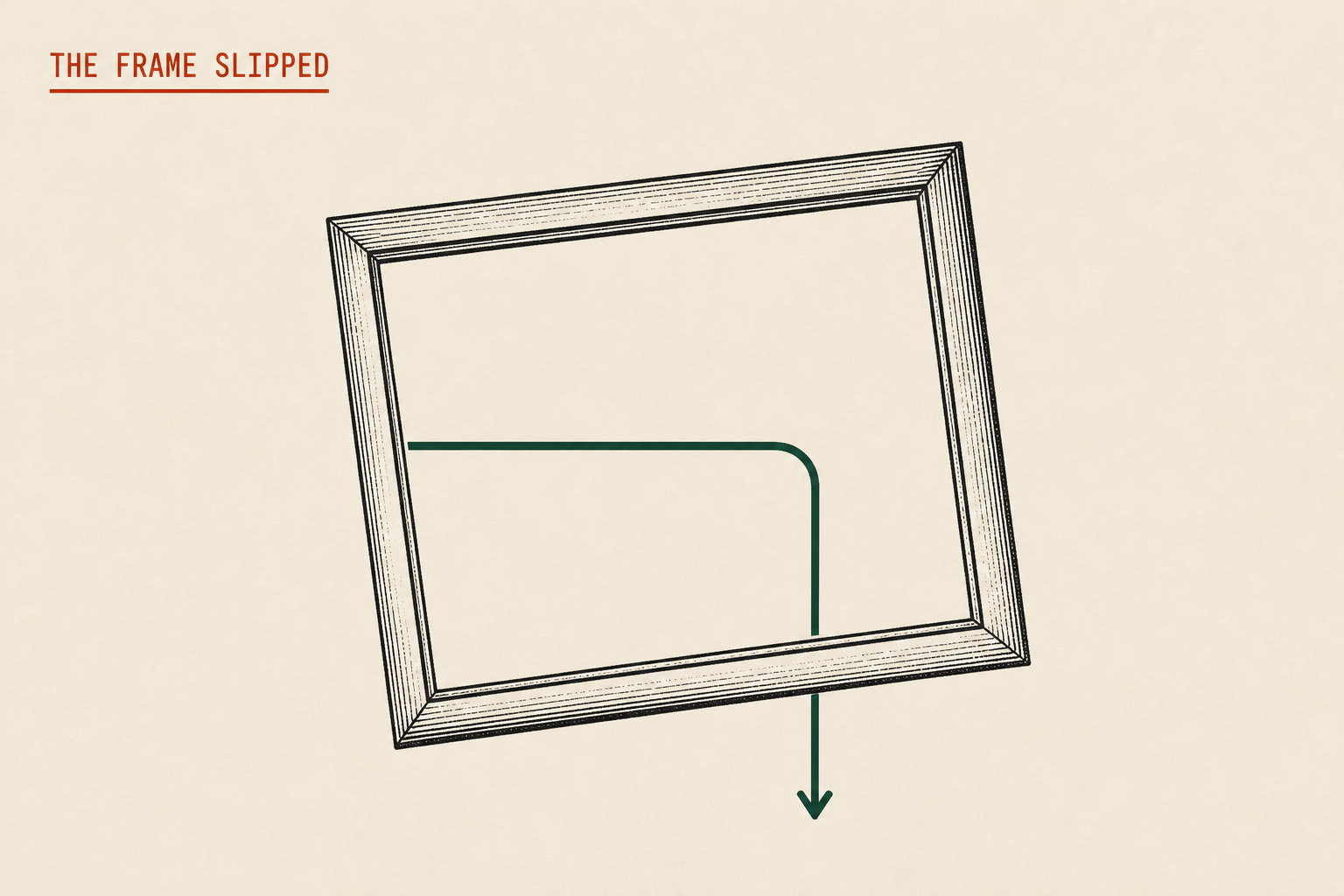
You can hear it. "Send me something and I'll get back to you" is the buyer leading. "As we agreed, next step is Thursday at two, and you'll have your partner on" is you leading. Most deals that "went quiet" didn't go quiet. They slipped from Leading to Chasing on one call, often in one sentence, and nobody noticed. I wrote about that here: the deal didn't stall, you lost the frame.
Holding frame: calm, not loud
This is where we part ways with Klaff.
Holding frame isn't dominance. Think of a good doctor. They have total authority in the room and they're not aggressive. They're calm. They ask questions. They listen. Then they tell you what happens next, and you follow, because they're clearly not rattled.
Holding frame is being the steadiest person on the call. We call that state Anchored. The opposite is Compliant: quietly adjusting yourself to the buyer's mood, softening your standards to match their pushback, hedging your certainty to match their hesitation.
Here's the part that surprises people. Compliant usually feels fine from the inside. The closer feels warm, helpful and accommodating. Nothing feels wrong. That's exactly why nobody catches it on the call. You only hear it on the recording.
Anchored doesn't mean rigid, either. You hold a few things and flex everything else:
- You hold: the diagnosis happens live, before the pitch. No discount before discovery. Your standards for who's a fit. Your boundaries.
- You flex: tone, pace, channel, timing, format, how the yes lands. Warm, curious, human.
Warm but immovable. That's the whole posture.
Frame grabs: the buyer taking over
A frame grab is the buyer trying to change what kind of conversation this is. It's not an objection. It's not a question. It's a move for control, and it usually sounds perfectly reasonable.
The four you'll hear every week:
| Grab | What the buyer says | What they're really doing |
|---|---|---|
| Process skip | "Just send me the proposal." / "Skip all that, what's the price?" | Taking the diagnosis off the table |
| Time pressure | "I've only got five minutes." | Squeezing the call so it can't go deep |
| Scope creep | "While you're at it, can you also…?" | Testing whether your boundaries bend |
| Authority insertion | "My friend who's a consultant said…" | Bringing in someone to outrank you |
The mistake is answering the grab on its own terms. If the buyer asks for the price at minute four and you give it, the call is now a negotiation, and holding your price is the awkward move. The fix is to calmly put your process back on the table and make it worth their while:
I'll get there. To give you a real number and not a generic one, I need ten minutes on what's actually going on. Fair?
Warm, direct, immovable. Then keep going.
Four kinds of "no", four different fixes
Most training calls every "no" an objection. That's why closers reach for the wrong fix. There are four kinds, and each needs something different:
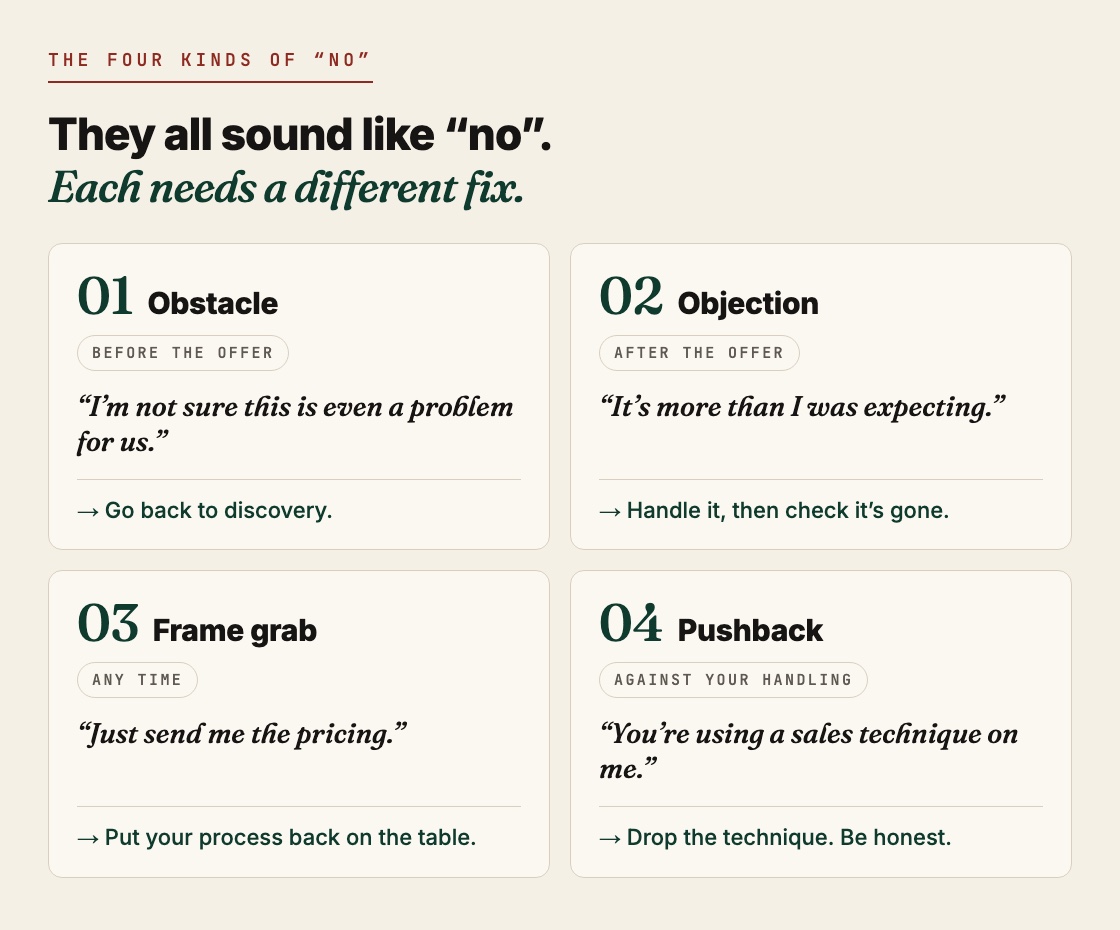
Name the kind of "no" before you answer it.
Get the kind wrong and the fix backfires. Treat a frame grab like an objection and you reward the grab. Treat pushback like an objection and you run a better technique on someone who's telling you they're tired of technique.
The beliefs: what has to be true before anyone says yes
Belfort was right that buyers need certainty. He was wrong about where it comes from. Certainty isn't something you pour into a buyer. It forms, belief by belief, from what the buyer sees and says for themselves.
There are six beliefs. Each one is a question the buyer is asking themselves, usually without saying it out loud:
| Belief | The buyer's quiet question |
|---|---|
| Pain | "Do I actually have a problem worth solving?" |
| Doubt | "Can I fix this myself?" |
| Cost of waiting | "What's staying the same actually costing me?" |
| Desire | "Is where I want to be worth the effort?" |
| Trust | "Do I trust the claims, this company, and myself to follow through?" |
| Solution | "Does this actually fix my problem?" |
The first three do the heavy lifting. If the buyer doesn't believe they have a real problem, that they can't fix it alone, and that waiting costs them something, they don't buy. Not today, and usually not later. No close technique fixes a missing belief. It only hides it until the refund request.
Then there are two things you check, not build:
- Money. Is the money there, and is it available for this, now? If it isn't, you qualify out. You don't talk someone into money they don't have.
- Who decides. Whose backing does this need? If the partner, the co-founder or the finance lead has to say yes, you get them into the room. You don't try to convince the person in front of you to overrule them.
Put the first three together and you get the gap in the buyer's own words: "I have a problem. It's costing me this. We want to be there." That's Gap Selling's best idea and SPIN's implication questions, landed together. The difference is who says it. The buyer names the gap with you. You don't hand it to them.
The leaks: what closers do to themselves
The buyer isn't the only one who gives the call away. Closers leak frame on their own, and it always sounds polite:
- Discounting before anyone asked. "…and I can do 10% if you sign this week."
- Skipping your own process. "Sure, I'll send the proposal over now."
- Asking permission. "Would it be okay if I asked a couple of questions?"
- Apologising for nothing. "Sorry to bother you, just checking in…"
- Hedging. "Honestly, I think this might sort of fit."
- Softening your own question. "What's your timeline? …or whatever works for you."
None of these loses a deal on its own. Together, they tell the buyer your standards are negotiable. So they negotiate.
The one test
Every method on this list has a way to push. Here's how we tell influence from manipulation, in one question:
Would it still work if the buyer knew you were doing it?
A good question still works when the buyer knows why you're asking it. A real deadline still works when they can see it's real. Fake scarcity doesn't. Painting a fear the buyer never raised doesn't. A borrowed ten-out-of-ten doesn't.
This isn't a morality lecture. It's about whether the yes lasts. A decision the buyer made clearly, on their own beliefs, holds up the next morning. A decision made in a state someone engineered tends to fall apart once the buyer calms down, and that's where refunds and chargebacks come from.
So which one is best?
It depends on the sale, and anyone who gives you one answer for every sale is selling you a course.
- Long enterprise deals with a buying group: Challenger for the conversation, MEDDIC for the forecast.
- Mid-market B2B: SPIN or Gap Selling for discovery, Sandler's up-front contract to open every call.
- High-ticket, closed in one or two calls: NEPQ's questions are the strongest starting point, as long as the buyer supplies the consequence and the closer doesn't.
- Any sale, in the tense minutes: Voss.
But here's what the choice doesn't change. Whichever method you pick, your closer still has to run it on a live call, against a buyer who wants to set the terms. That part is the same in every sale.
Keep your method
Here's the part that matters for your team.
You don't have to throw anything out. Frame State Selling isn't competing with the seven above. It runs underneath them.
- Running MEDDIC? Keep it for your forecast. Frame State Selling reads the same ground (who decides, whether the money's there, whether the pain is real) from what the buyer actually said, so a box can't go green on hope. And it tells you whether your champion is still leading the deal or has gone quiet on you.
- Running SPIN or Gap Selling? Keep your questions. Frame is what gets you permission to ask them.
- Running Sandler? Your up-front contract is a frame move. Now you can see when it slipped.
- Running NEPQ? Keep the questions and the tone. Let the buyer fill in the consequence, and don't fill it in for them.
- Running Challenger? Keep the insight. Frame is the "take control" part the books go lightest on.
You keep your method. Frame State Selling is the layer underneath.
Why the method never makes it onto the call
Back to Rackham, because he said the quiet part nearly fifty years ago.
In a 1979 article, he cited a Xerox study showing that without follow-up coaching, 87 per cent of the skills change from the training was lost. (You'll see "87% within 30 days" and "84% within 90 days" all over LinkedIn. The 30 days was added later, and the 84% has no source I can find. The real version is bad enough.)
That's the real problem with all seven methods. Not that they're wrong. They're good. The problem is that a method lives in a binder, a course or a closer's memory, and the deal gets decided on a Tuesday call at minute fourteen with nobody there to catch the slip.
A great sales manager fixes that by listening to the calls and saying, "There. That's where you handed it over. Let's practise that." Most teams don't have one. The ones that do have one who can't listen to every call.
Seven great methods. One layer underneath. If you want the full theory behind it, it's here.
Written by
George
Founder, 1Close
Building the AI sales manager. Frame State Selling on every live call.
Building the AI sales manager. Writes about high-ticket closing, frame, and how founder-led sales teams actually scale.
Frame State Selling® · Frame Intelligence Engine®
Keep reading
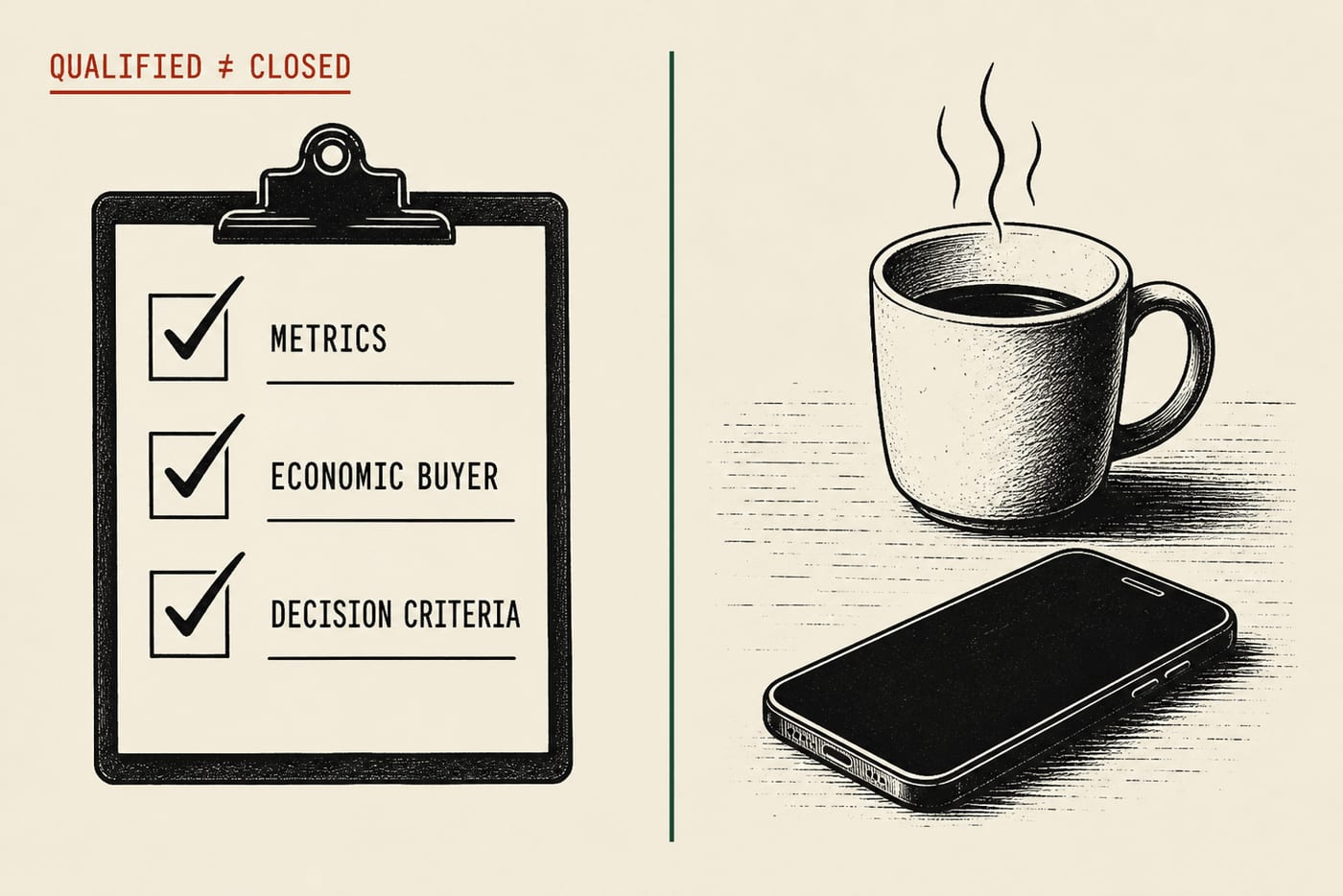
MEDDIC gets qualification right and closes wrong. Here's why.
MEDDIC qualifies the deal. It cannot tell you the frame slipped at 4:32. Founders who stop at the scorecard keep losing deals that were already dead.
8 August 2026 · 8 min read
The deal didn't stall. You lost the frame.
"Let me think about it" is rarely about thinking. It's the sound of a frame you stopped holding three questions ago. Here's how to spot the handover and take it back.
12 June 2026 · 3 min read