The best AI tools for real-time sales call coaching in 2026, and what each one reads.
15 real-time sales call coaching tools checked against their own pages: where each runs, what the live prompt reads, and the price. For teams selling on Zoom.
What the live prompt reads
A battlecard
Same card for every buyer
This buyer
What they said on this call
Minute 31, the price objection. Which card do you want on screen?

George
27 September 2026 · 21 min read
Building the AI sales manager. Frame State Selling on every live call.
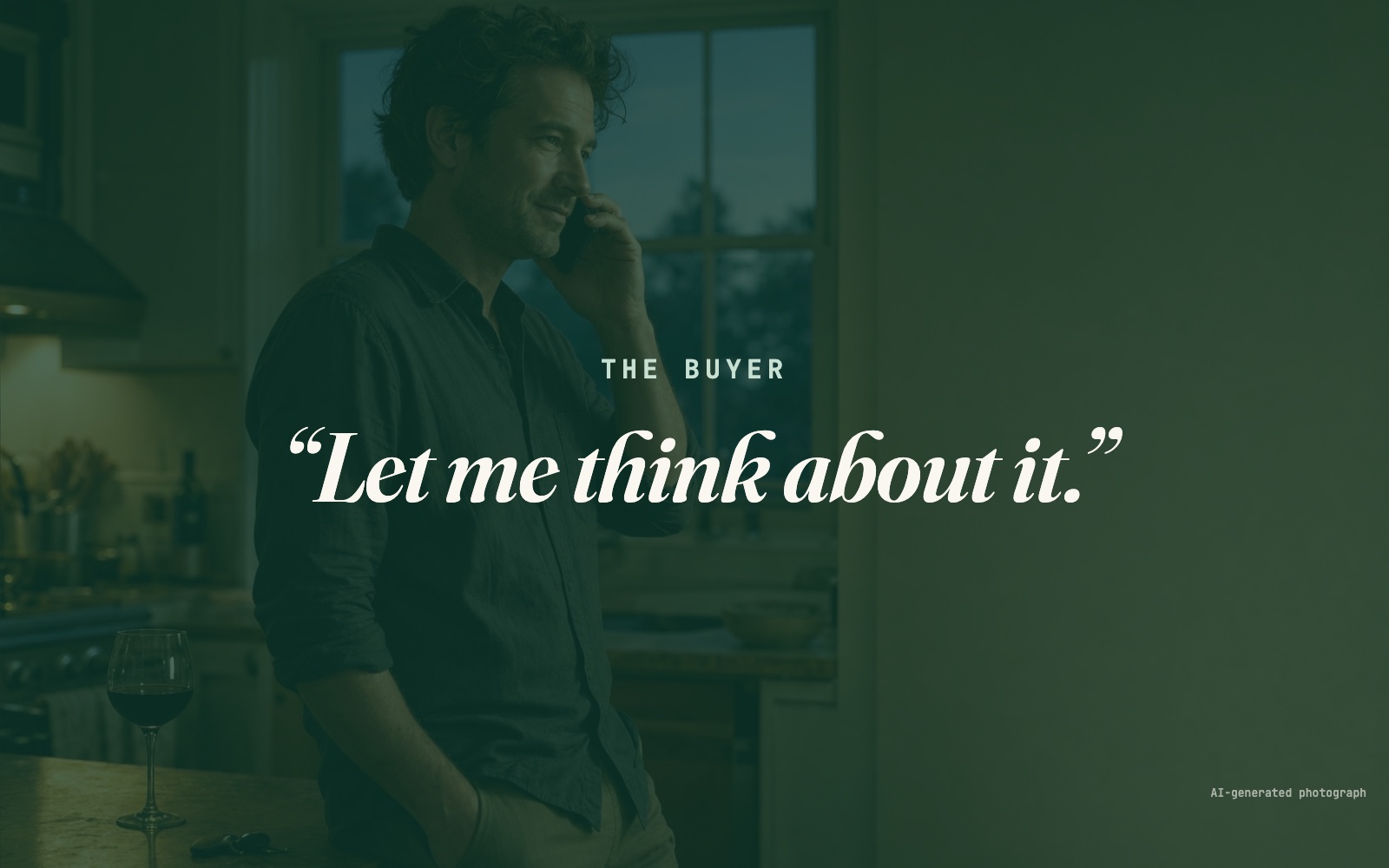
Minute thirty-one. The buyer says, "It makes sense, I just need to think about it."
A card flashes up on your closer's screen: Acknowledge the concern. Ask what specifically they need to think about.
Your closer already knew that. Every closer knows that. What they didn't know is that twenty minutes earlier the buyer said their wife handles the money, and nobody asked whether she'd be on the call.
That's the real question behind every real-time sales call coaching tool in 2026. They can all put something on the screen while the call is live. The difference is what the prompt reads before it decides what to show.
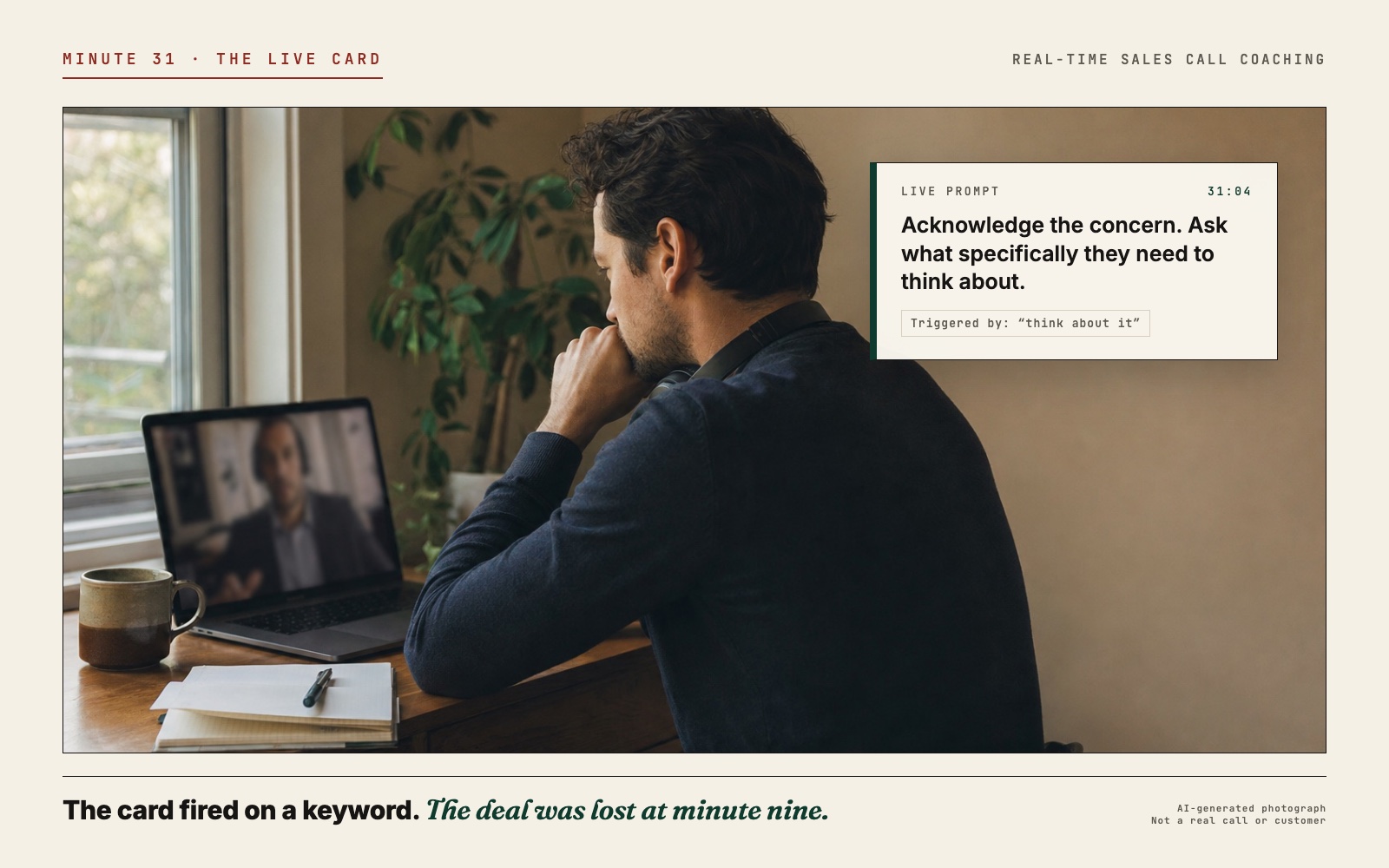
Minute 31. The card fired on "think about it". The deal was lost at minute nine. Not a real call or customer.
I checked fifteen of them against their own product pages on 27 September 2026. Not review sites, not other vendors' comparison posts. Some of the "best tools" lists ranking for this search describe live features the vendors themselves don't claim. Here's what each one actually does.
What is real-time coaching on a sales call?
Real-time sales call coaching (vendors also call it real-time agent assist, live battlecards or in-call guidance) is software that listens to a live call and shows the rep a prompt on screen while the buyer is still talking. The prompt might be an answer to a question, a reply to an objection, a checklist item or a nudge like "you've been talking for two minutes". It runs in one of three places: a contact-centre phone system, a sales dialer, or a video call on Zoom, Google Meet or Teams. That's different from conversation intelligence, which records and analyses the call afterwards. Many tools now do both.
Does real-time AI assist actually work?
Yes, with a catch about who it helps.
The biggest field study of real-time AI help is Brynjolfsson, Li and Raymond in the Quarterly Journal of Economics (2025). 5,172 support agents got an AI assistant that suggested replies during live chats. Issues resolved per hour rose 15% on average and 30% for the least experienced agents. The most skilled agents saw small drops in quality.
In sales specifically, Luo, Qin, Fang and Qu in the Journal of Marketing (2021) ran randomised field experiments with AI coaching on sales floors. Middle-ranked agents improved the most. The weakest drowned in the feedback. The strongest resisted it. AI plus a human coach beat either one alone.
Average lift
15% more issues resolved per hour, 5,172 agents (QJE, 2025)
Who gains most
The middle of the team, not the top or the bottom (Journal of Marketing, 2021)
What drowns people
Too much feedback at once. Newer reps stop listening to the buyer
Two honest caveats. The QJE study is customer support, not sales. And nobody has run a randomised trial on AI roleplay for salespeople yet. I looked. So the evidence says live help works, works most for the middle of your team, and works worst when it throws too much on the screen.
How I judged them
Five questions, asked of every tool:
- Where does it run? Contact-centre phone queue, sales dialer, or video call. Most buyers skip this question and then find out the tool doesn't work on their calls.
- Does it prompt during the call? Checked against the vendor's own page, not a reseller's blog.
- What does the prompt read? A battlecard a manager wrote, your top performers' past calls, a script, or generic AI.
- What happens after the call? Scoring, CRM notes, a follow-up draft, practice.
- What does it cost to find out? Published price or "talk to sales".
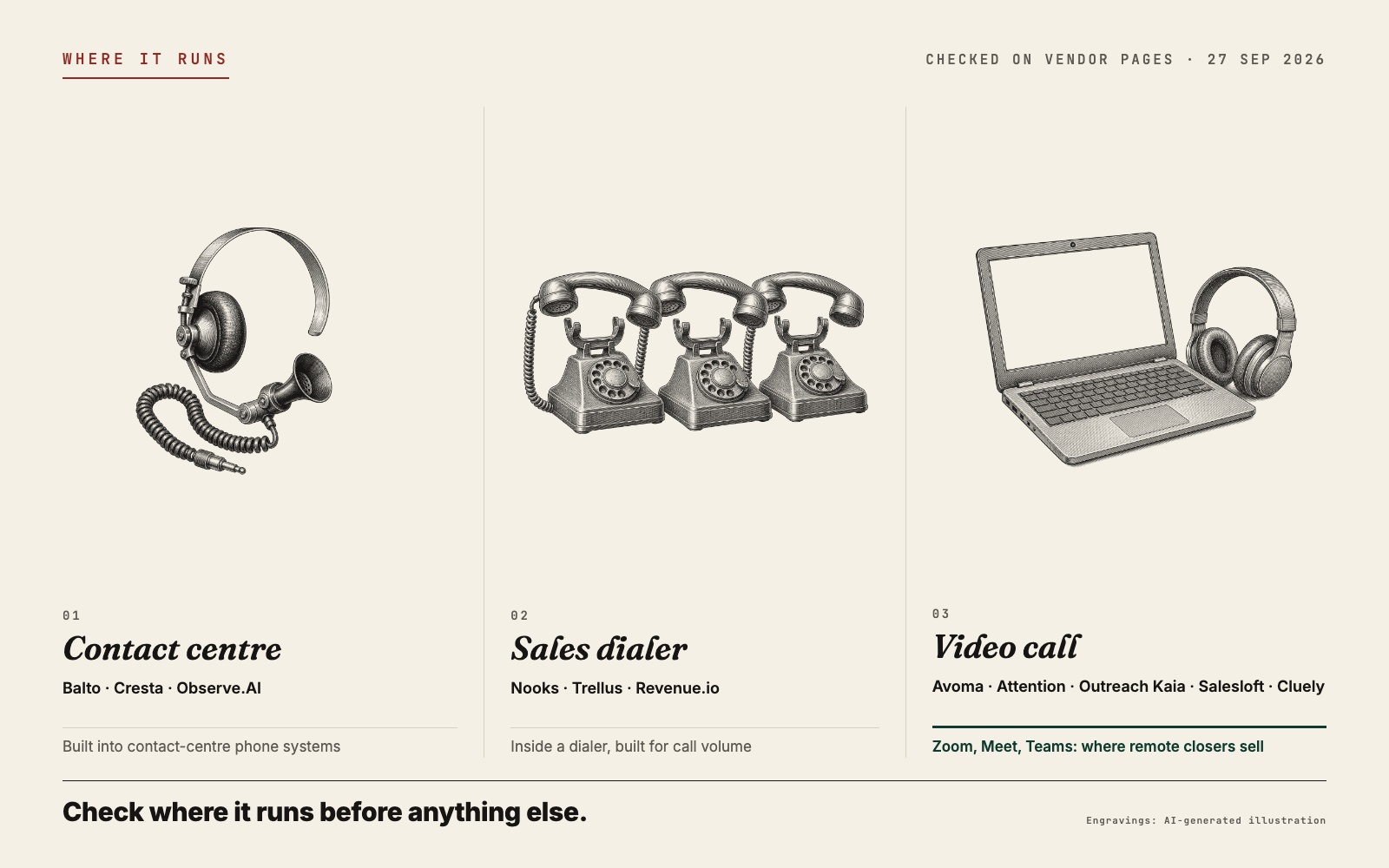
Where each tool runs, checked on the vendors' own pages on 27 September 2026.
The comparison table
Prices are as listed on each vendor's pricing page on 27 September 2026. "Custom" means no public price.
| Tool | Live prompt during the call? | What the prompt reads | Where it runs | Listed price |
|---|---|---|---|---|
| Balto | Yes | Scripts, checklists, your knowledge base | Contact-centre phone systems | Custom |
| Cresta | Yes | Your top performers' behaviour and knowledge | Contact-centre phone systems | Custom |
| Observe.AI | Yes | Context and "next-best action" | Contact centre | Custom |
| Salesloft (incl. Clari Copilot) | Yes | Battlecards | Salesloft platform | Custom |
| Outreach Kaia | Yes | Live battlecards and content cards | Video meetings | Custom |
| Attention | Yes | Battlecards | Zoom, Meet, Teams | Not published |
| Avoma | Yes | Trigger phrases and cards a manager writes | Zoom, Meet, Teams, phone | From $19/seat/mo (annual) |
| Revenue.io | Yes | Battlecards, next best actions | Salesforce dialer | Not published |
| Nooks | Yes | Battlecards, proven talk tracks | Its own parallel dialer | Custom |
| Trellus | Yes (top tier) | Talk tracks, objection scenarios | Dialer inside your sales engagement tool | Custom for live coaching |
| Cluely | Yes, when the rep presses a key | Generic AI plus files you upload | Zoom, Meet, Teams, Webex | From free, Pro $19.99/mo |
| Gong | A talk-time alert | A rule: over 2.5 minutes talking | Gong app for Zoom | Custom |
| Chorus by ZoomInfo | Not on its product page | n/a | Notetaker | Custom |
| Kendo | Not on its product pages | n/a (scores after the call) | Imports your recordings | $55 to $100/seat/mo |
| Sybill | No | n/a (post-call) | Meeting recorder | From free |
Look down the third column. Eight of the eleven tools with live prompts show some version of a pre-written card or script. That's not a criticism. A good battlecard is useful. But it tells you what the category is really selling.
Group 1: built for contact centres
These three give the most mature live guidance on the list. They were built for agents on phone queues, and it shows in where they plug in.
Balto
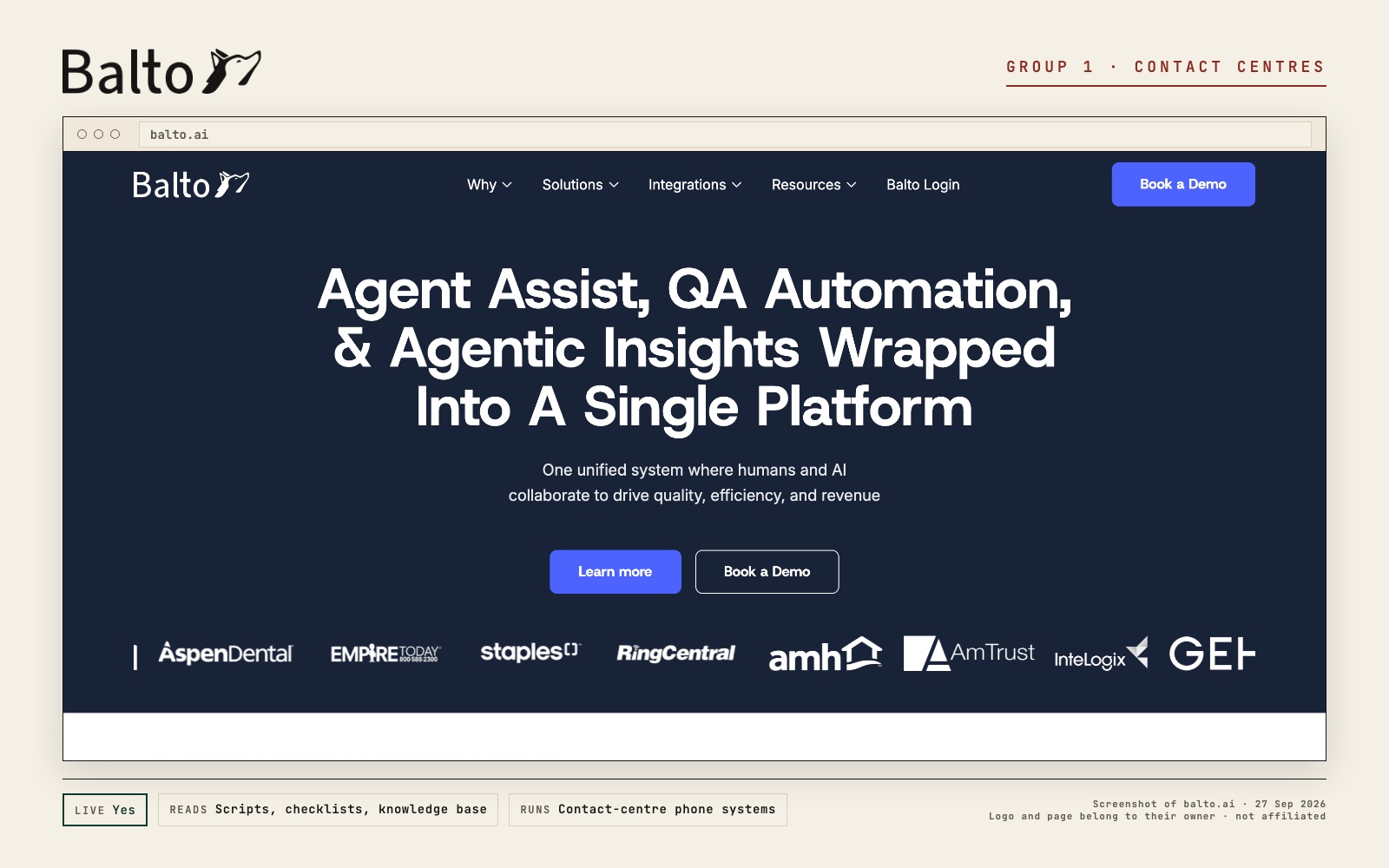
balto.ai, 27 September 2026. Logo and page belong to Balto. 1Close is not affiliated.
Live prompts, compliance checklists and coaching alerts during the call. It pulls answers from your knowledge base in real time. After the call it writes summaries and scores quality. Its customers are contact centres in health insurance, banking, collections and home improvement.
Best for: a phone-based sales floor inside a contact-centre stack, especially in a regulated industry. Watch for: it runs on contact-centre phone systems (Five9, Genesys, NICE, RingCentral). If your closers sell on Zoom, check first.
Cresta
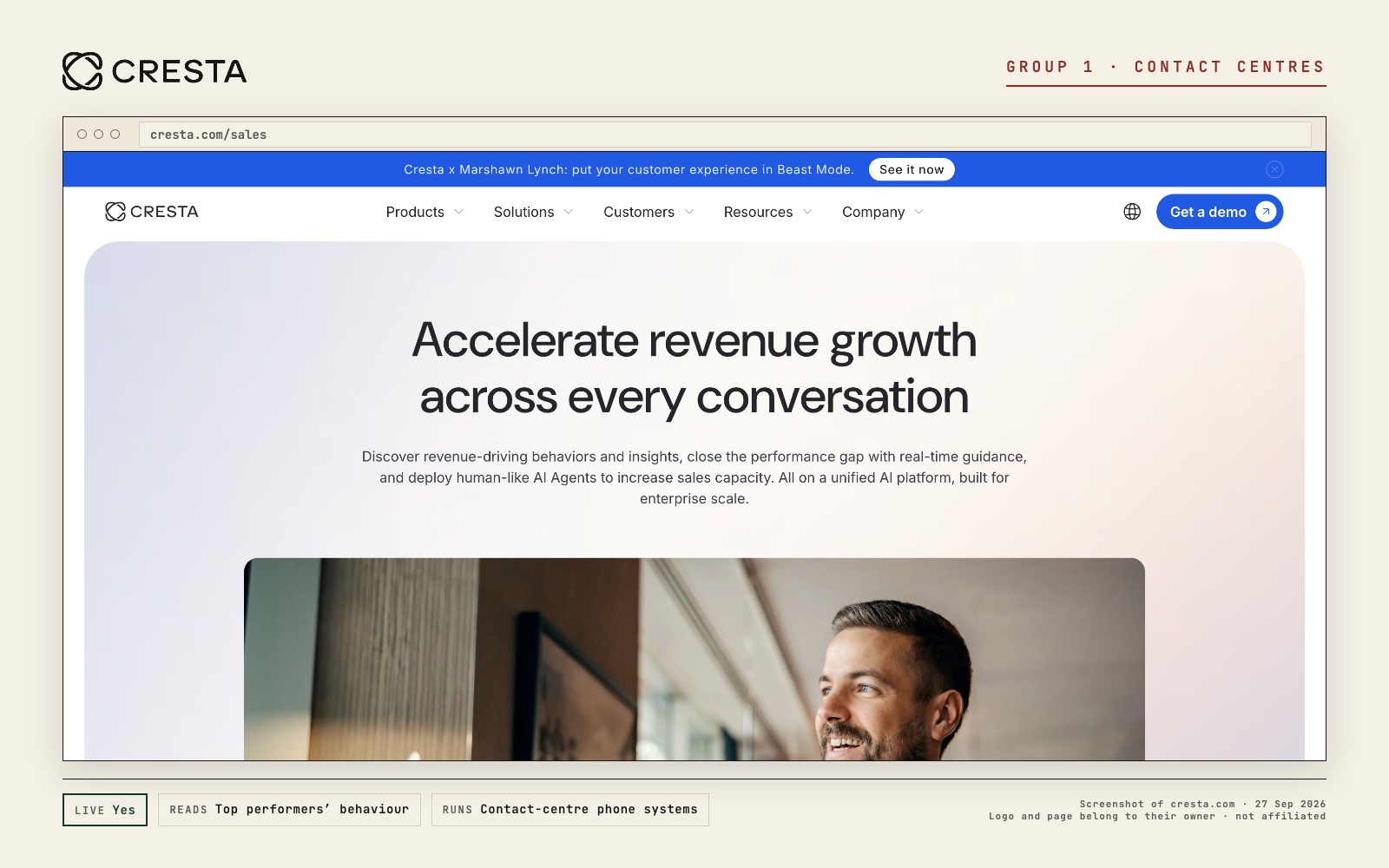
cresta.com/sales, 27 September 2026. Logo and page belong to Cresta. 1Close is not affiliated.
Real-time prompts, answers and coaching during sales calls, modelled on what your top performers do. After the call, automated quality scoring on every interaction. Built for enterprise scale; its customers include United, Marriott and Cox.
Best for: large teams with enough calls to learn what the best reps do differently. Watch for: enterprise deployment and custom pricing. A four-closer team doesn't have the call volume the model learns from.
Observe.AI
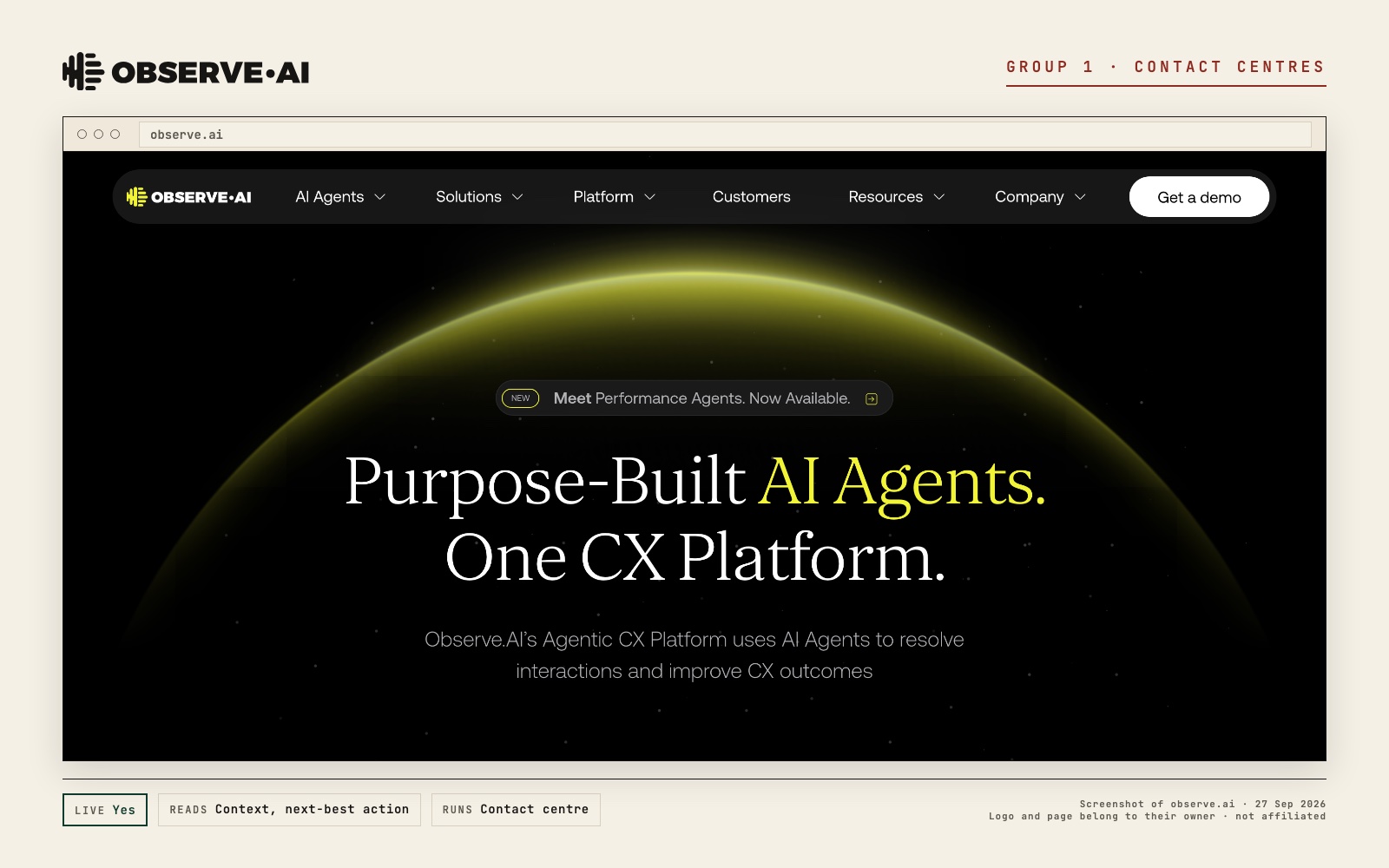
observe.ai, 27 September 2026. Logo and page belong to Observe.AI. 1Close is not affiliated.
Real-time assist through its Companion Agent: context, a suggested next action and automated steps during the call, plus coaching generated afterwards. Its customers (DoorDash, SoFi, Asurion) are mostly customer experience teams.
Best for: enterprise contact centres that sell and serve on the same floor. Watch for: the product is framed around customer service, not sales calls on video.
Group 2: sales platforms with live battlecards
These are the tools most Zoom-based sales teams will actually shortlist. Nearly all of them show a battlecard: a pre-written answer that appears when the buyer says a trigger word.
Salesloft (now including Clari Copilot)
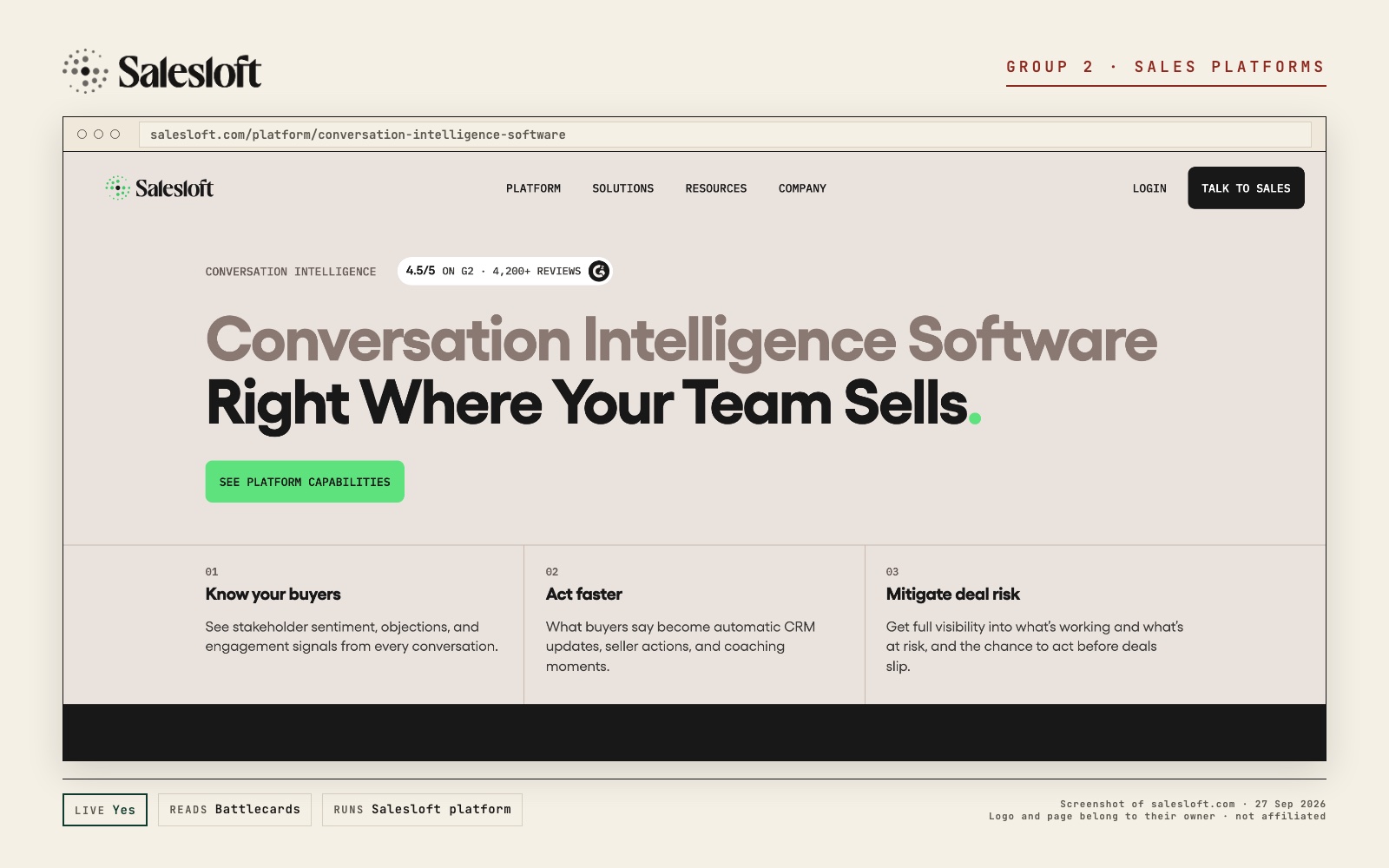
salesloft.com, 27 September 2026. Logo and page belong to Salesloft. 1Close is not affiliated.
Clari Copilot's page now redirects to Salesloft after the two companies merged. Salesloft promises "real-time AI guidance during calls to handle objections" and battlecards that "surface in real time on every call". After the call: summaries, follow-up drafts, CRM updates, scoring and coaching tasks.
Best for: teams already running outbound and forecasting in Salesloft. Watch for: the merger is recent. Ask which call recorder you'd actually be on.
Outreach Kaia
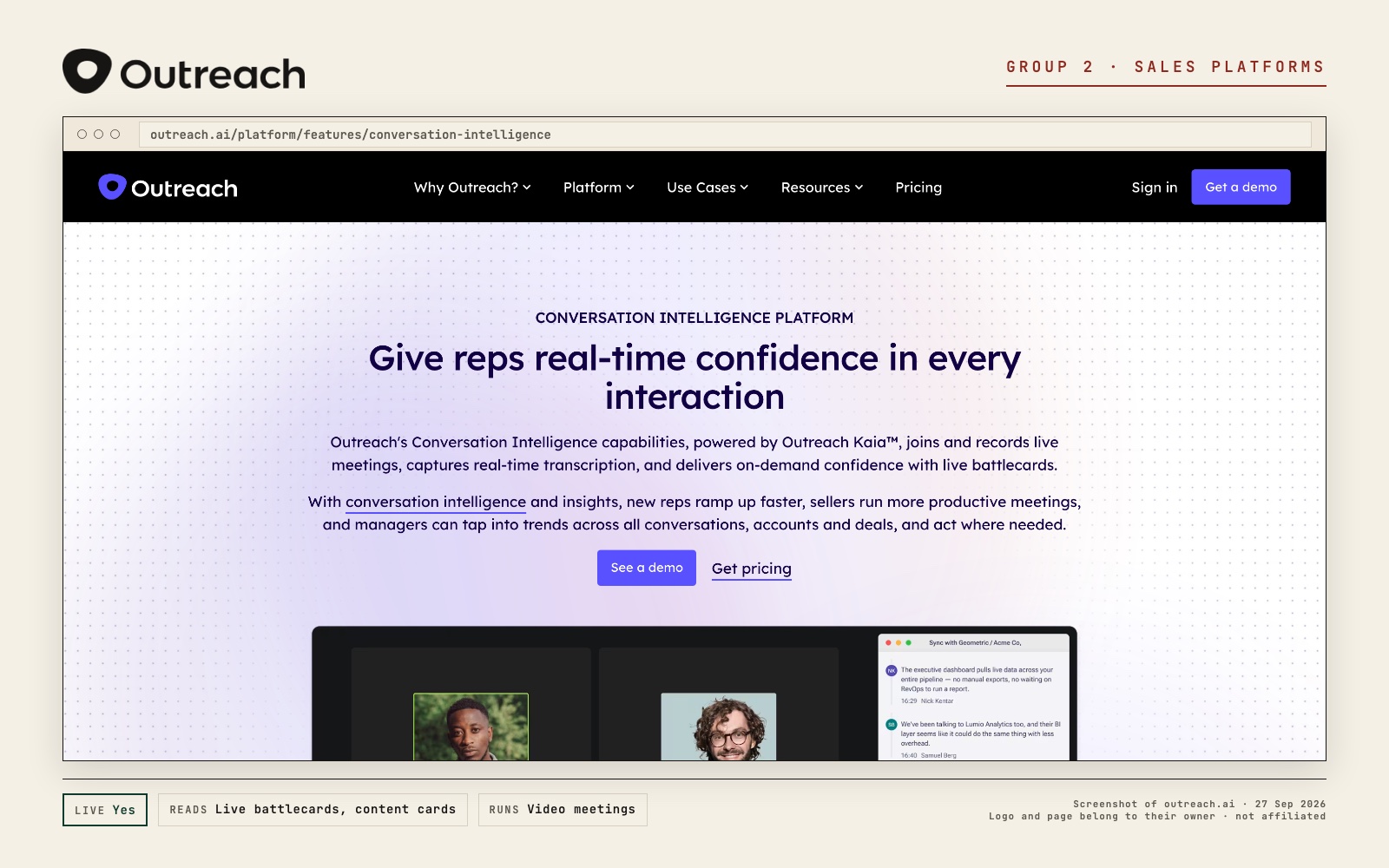
outreach.ai, 27 September 2026. Logo and page belong to Outreach Kaia. 1Close is not affiliated.
Kaia joins your meetings, transcribes live and shows battlecards and content cards on request. After the call: summaries, follow-ups with action items and CRM updates. There's an option to record only the seller's side.
Best for: teams living in Outreach. Watch for: pricing is seats plus AI credits, quoted on request.
Attention
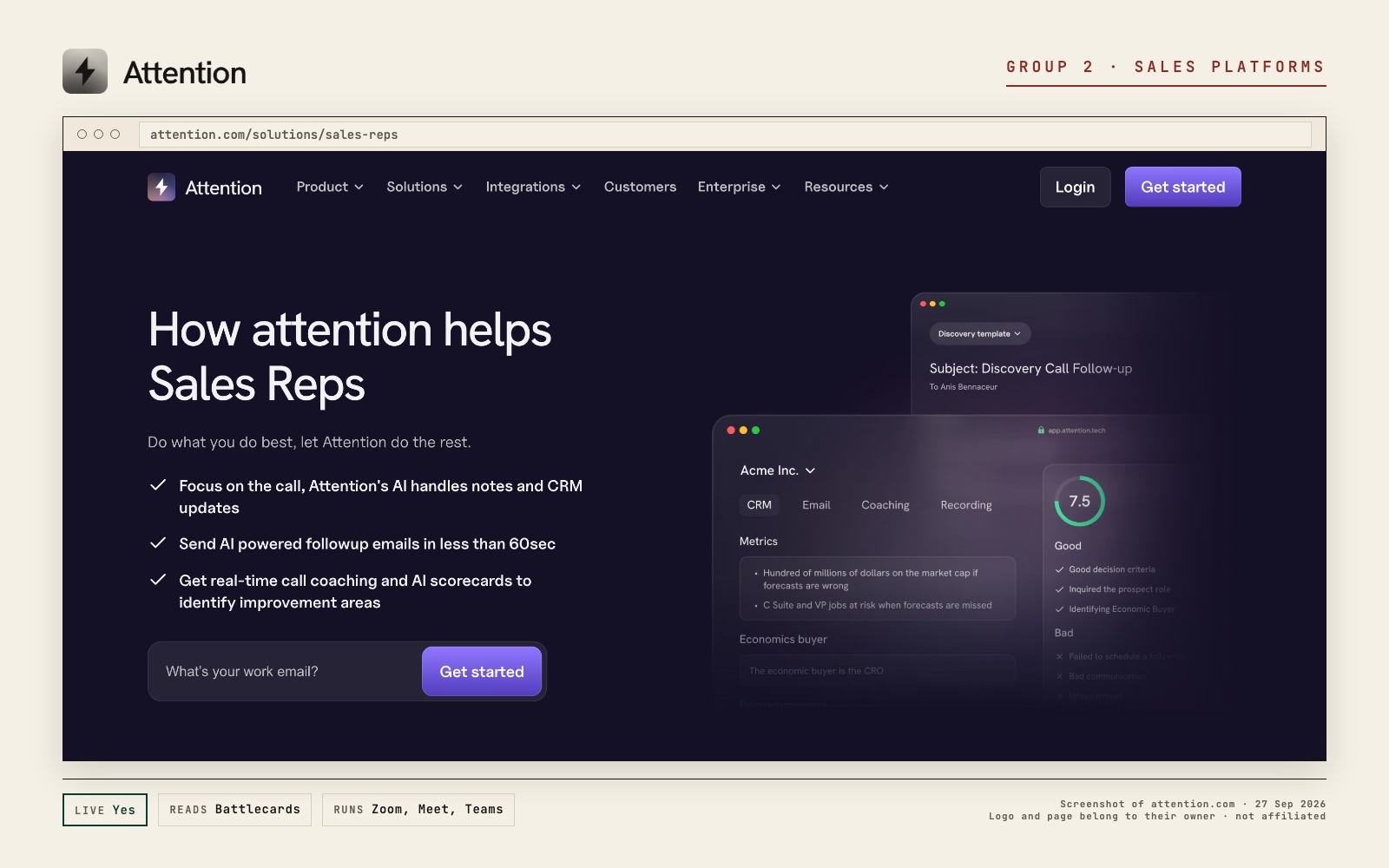
attention.com, 27 September 2026. Logo and page belong to Attention. 1Close is not affiliated.
AI battlecards to "answer any prospect question while on the call", on Zoom, Meet and Teams. Heavy post-call automation: CRM notes, follow-ups in under a minute, scorecards.
Best for: video-first teams that want live answers and less admin. Watch for: no public pricing.
Avoma
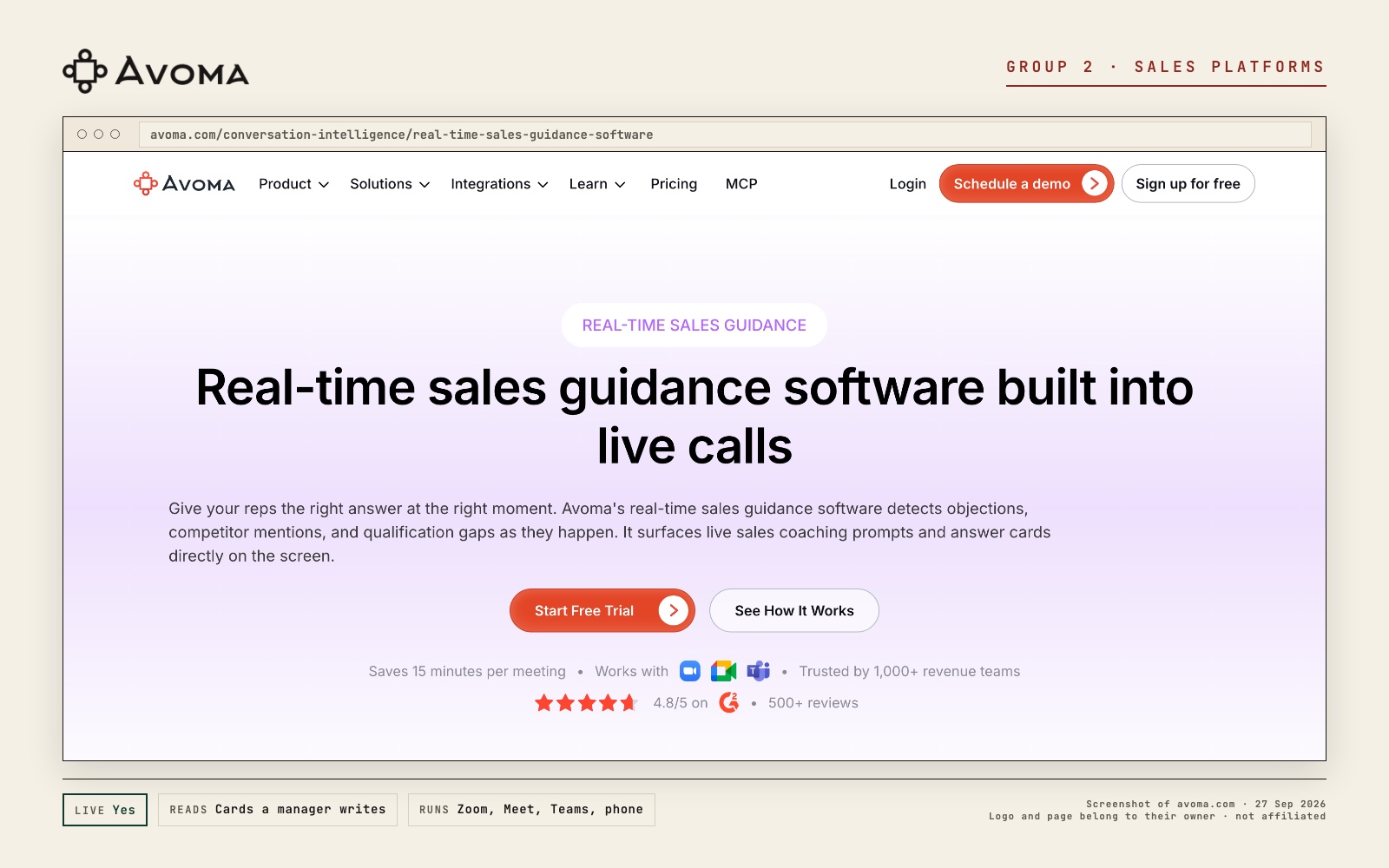
avoma.com, 27 September 2026. Logo and page belong to Avoma. 1Close is not affiliated.
Avoma is the most transparent tool here. It "detects trigger phrases, buyer signals, and objections in real time, then displays the relevant answer card", and says cards stay on screen for 20 seconds. Your manager writes the triggers and the approved answers. It works on Zoom, Meet, Teams, phone and in person.
Best for: a small team that wants live cards on video calls at a published price. Watch for: the cards are only as good as what your manager writes. There's a 10-seat minimum on Enterprise, and conversation intelligence is a $29/seat add-on.
Revenue.io
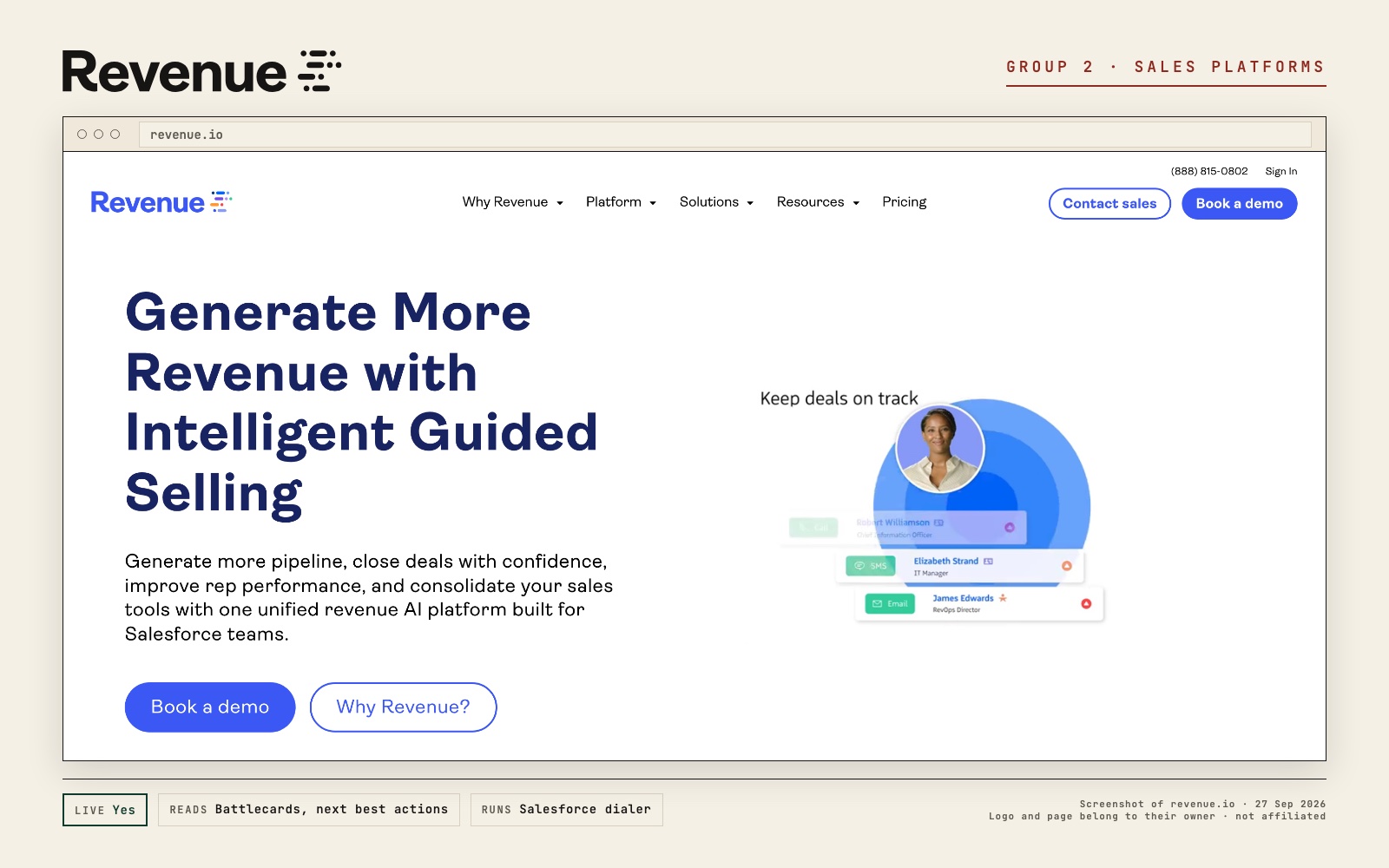
revenue.io, 27 September 2026. Logo and page belong to Revenue.io. 1Close is not affiliated.
Battlecards and "next best actions" during calls, inside its own Salesforce dialer, with Zoom, Meet and Teams connected. Methodology scorecards afterwards.
Best for: Salesforce teams. It says it's built for 15 or more seats. Watch for: no Salesforce, no fit.
Group 3: dialers, overlays and post-call tools
Nooks
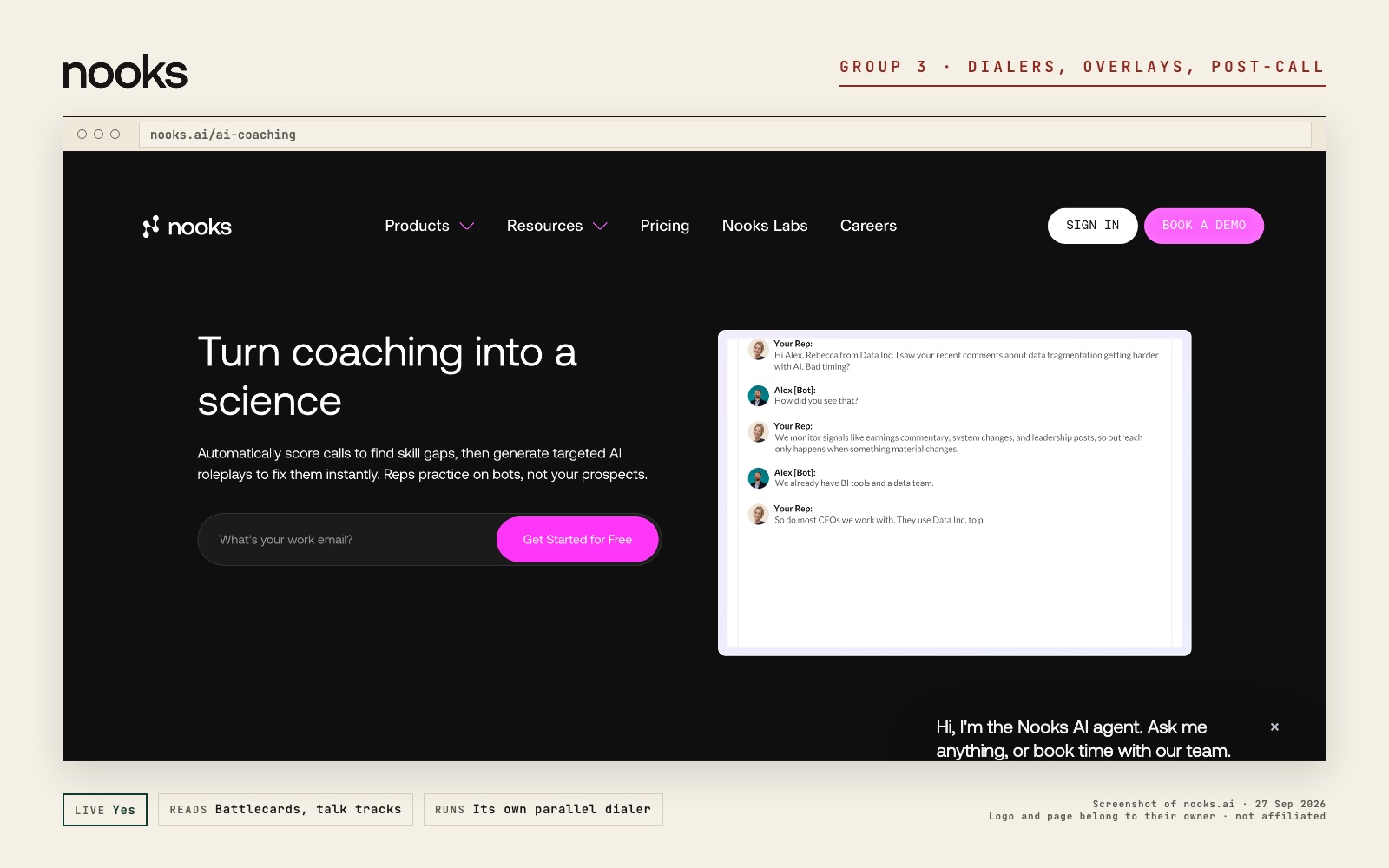
nooks.ai, 27 September 2026. Logo and page belong to Nooks. 1Close is not affiliated.
A parallel dialer for outbound. Live battlecards "pop up the right talk track the moment an objection or competitor comes up". It also scores every call and lets reps practise on AI buyers.
Best for: SDR teams making a lot of cold calls. Watch for: it's built around the dialer. For booked video meetings, check first.
Trellus
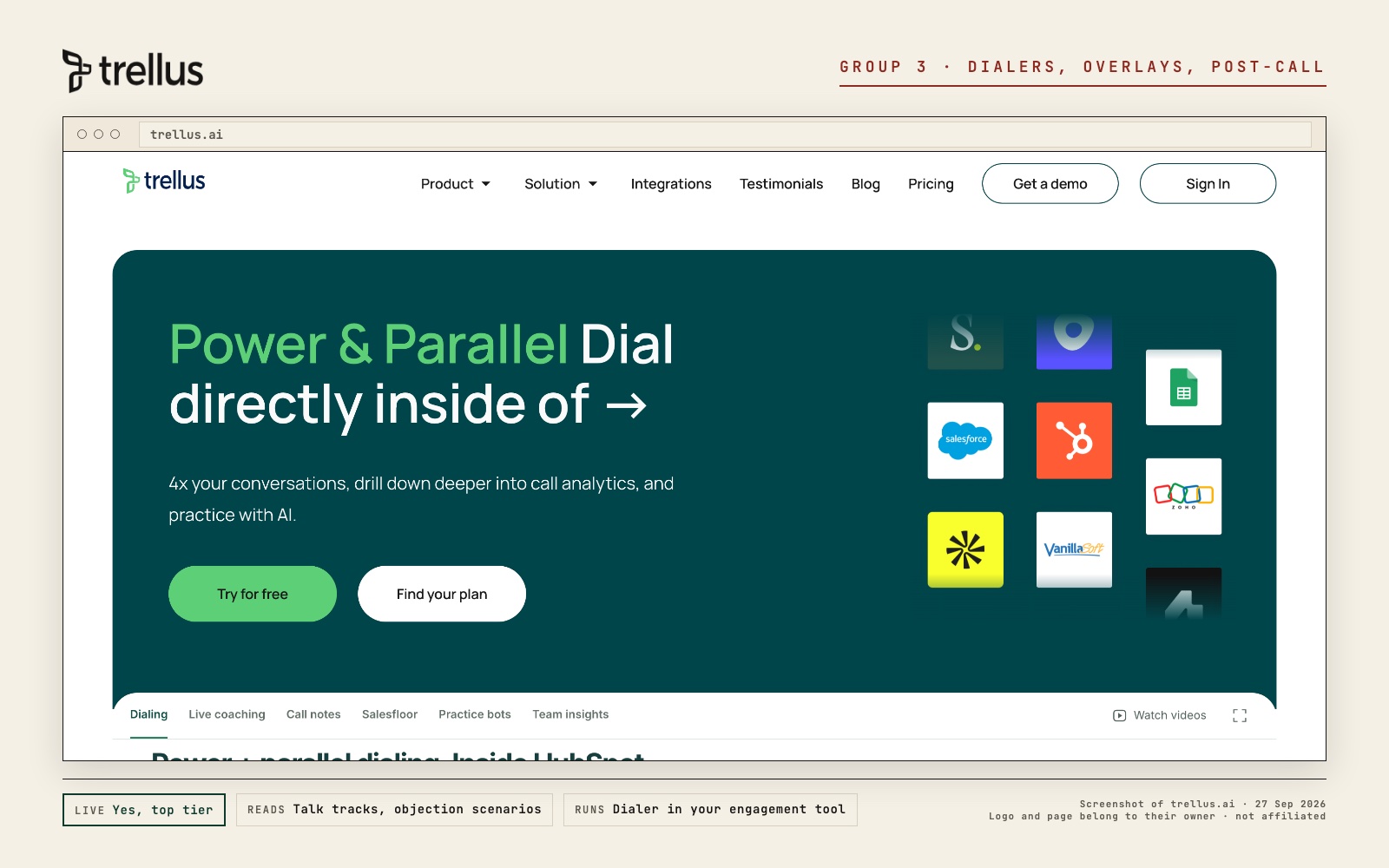
trellus.ai, 27 September 2026. Logo and page belong to Trellus. 1Close is not affiliated.
Live guidance on objections and competitors inside the dialer of your sales engagement tool (Salesloft, Outreach, HubSpot, Apollo), with prebuilt objection scenarios you can edit.
Best for: outbound reps who want live objection help without switching tools. Watch for: live coaching sits on the custom-priced tier. No Zoom listed.
Cluely
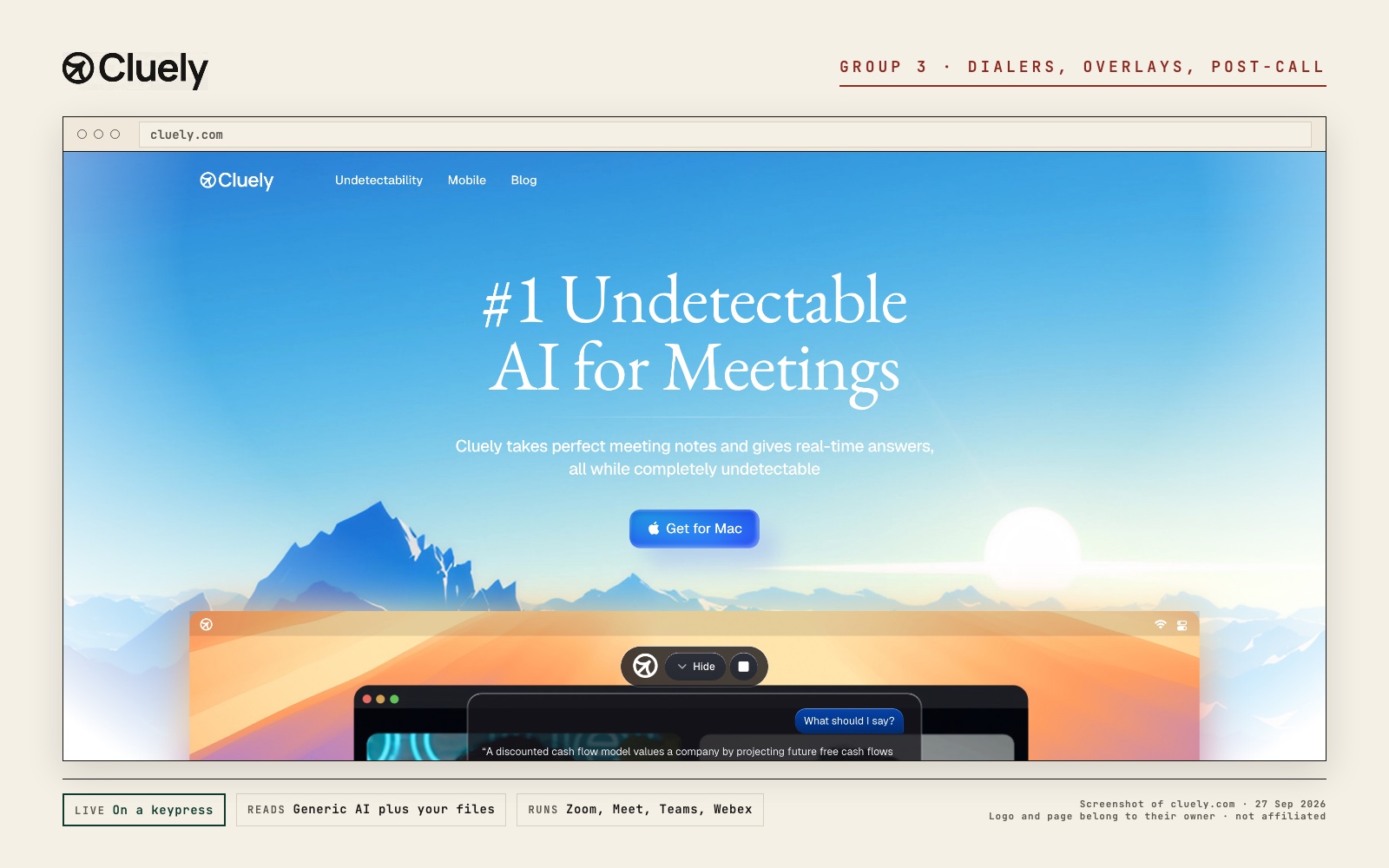
cluely.com, 27 September 2026. Logo and page belong to Cluely. 1Close is not affiliated.
A hidden overlay for any video call. The rep presses a key and asks "What should I say?". It also sells "undetectability": no bot joins, and it's hidden from screen share.
Best for: a solo seller who wants instant answers for very little money. Watch for: the answers are generic AI plus whatever files you upload. There's no sales method, no scoring and no memory of the deal. Also think about whether you want a tool whose selling point is that the buyer can't see it, on a call where they're about to pay you.
Gong
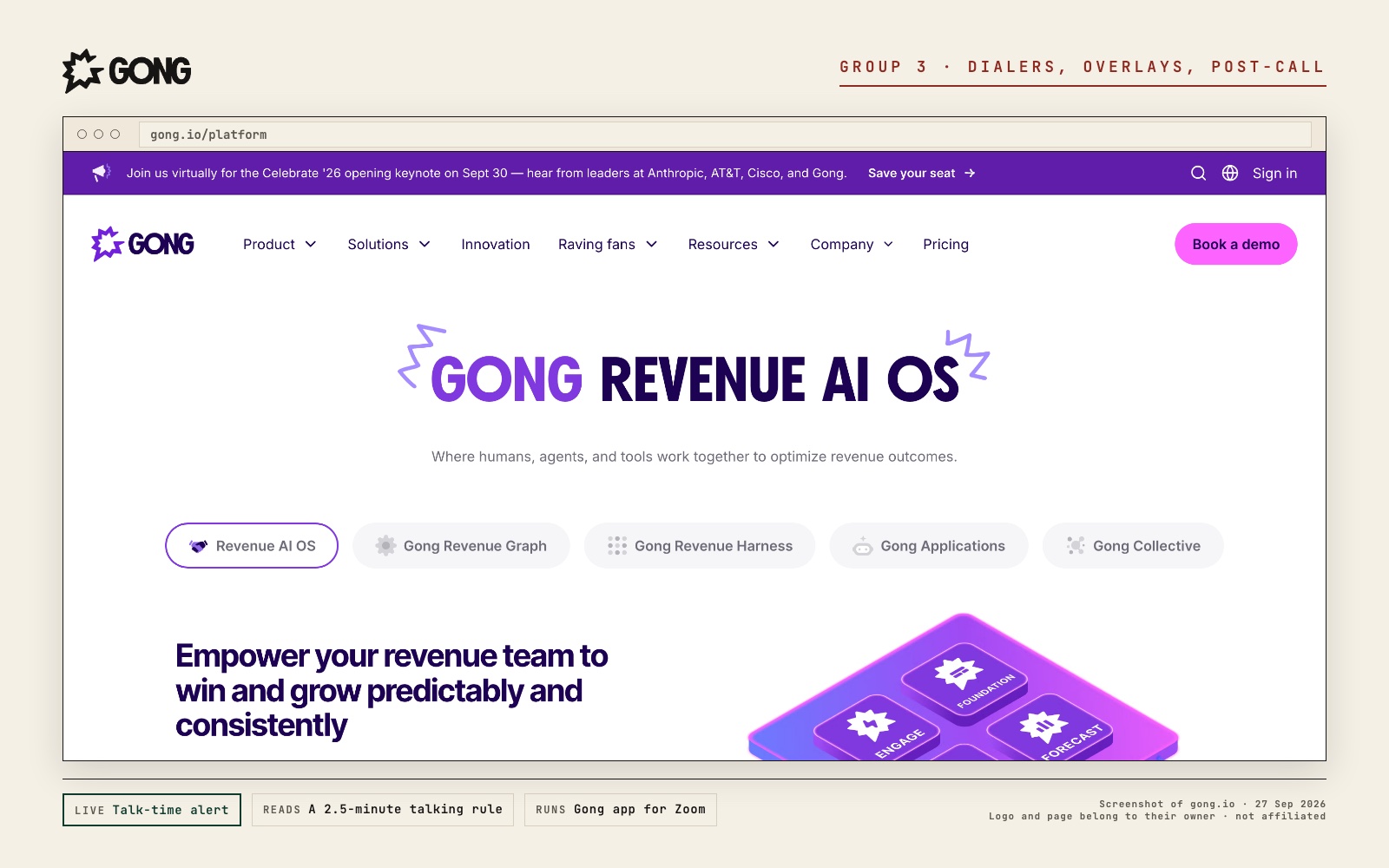
gong.io, 27 September 2026. Logo and page belong to Gong. 1Close is not affiliated.
Gong is the deepest post-call and deal intelligence platform on this list. Its Zoom app shows a live transcript and notes, and alerts you "if you've spoken for more than 2.5 minutes". Several comparison posts describe a real-time coaching add-on called "Gong Assist". I couldn't find it on Gong's own site.
Best for: larger teams with managers who review deals and forecast. Watch for: don't buy Gong for live prompts. Buy it for what it does after the call.
Chorus by ZoomInfo
zoominfo.com, 27 September 2026. Logo and page belong to ZoomInfo. 1Close is not affiliated.
Transcripts, insights, scorecards and talk-time metrics, tied to ZoomInfo's contact data. Its product page describes no live prompts.
Best for: teams already on ZoomInfo.
Kendo
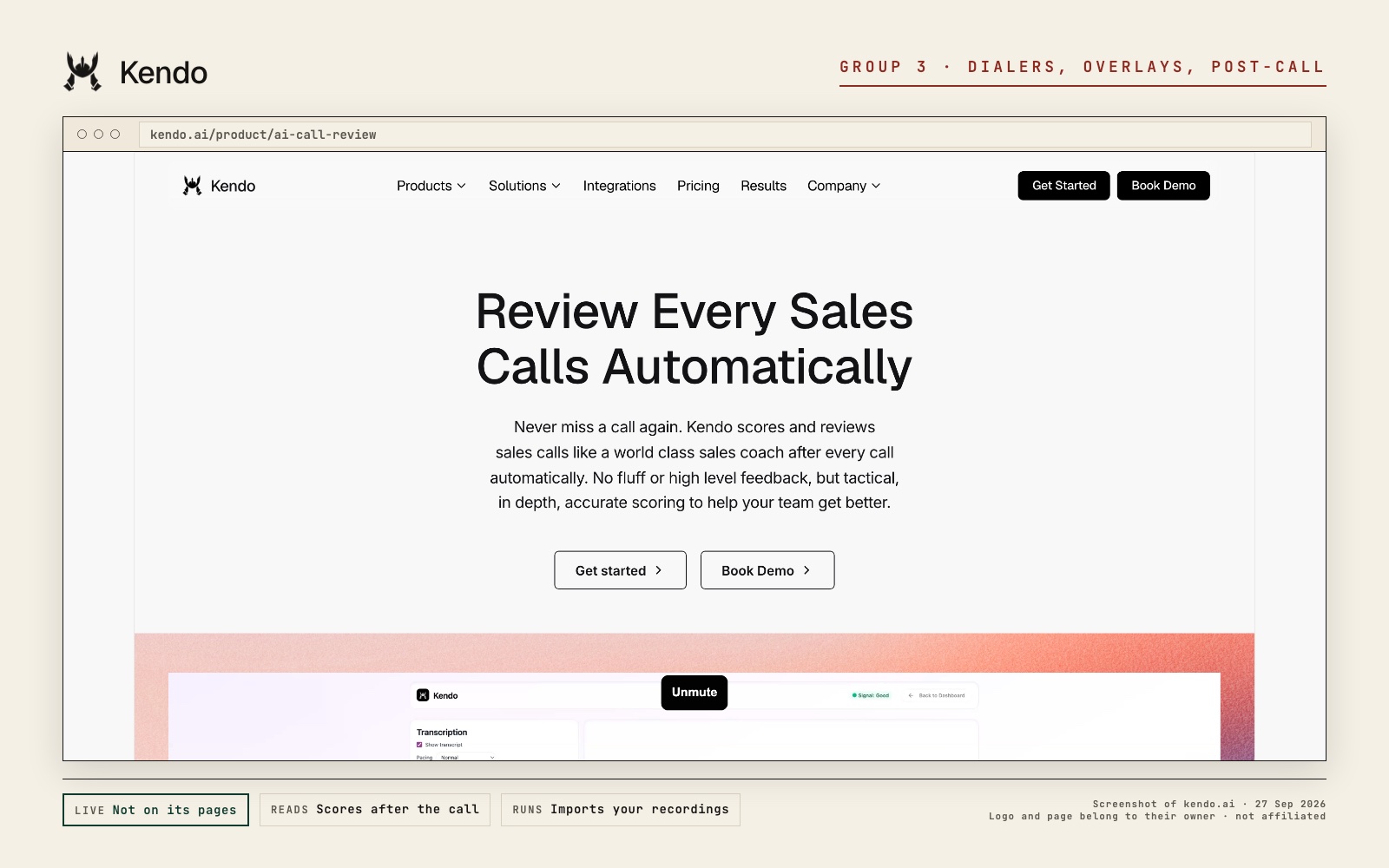
kendo.ai, 27 September 2026. Logo and page belong to Kendo. 1Close is not affiliated.
One custom scorecard for real calls and for AI roleplay, with scoring "after every call". It publishes prices: $55 and $100 per seat a month. Its blog talks about real-time coaching; its product pages describe scoring after the call and guidance during practice.
Best for: teams that want the same scorecard on practice and real calls.
Sybill
sybill.ai, 27 September 2026. Logo and page belong to Sybill. 1Close is not affiliated.
Post-call only, and good at it: CRM fields updated after every call, follow-up emails, summaries, pre-meeting briefs.
Best for: closers drowning in admin.
Where does a live prompt help on a high-ticket call?
A live prompt helps when the buyer asks something and the rep doesn't know the answer. It can't help when the rep forgets to ask something, because nothing triggers the card.
That matters more than any feature on the list, because on a high-ticket sales call a lot of the expensive misses are questions nobody asked. Walk through the call:
| Part of the call | The common miss | Can a keyword-triggered card catch it? |
|---|---|---|
| The opening | Buyer sets the agenda ("I've only got 20 minutes, can you just show me the price?") and the closer agrees | Sometimes. "Price" is a keyword |
| Discovery | Nobody asks who else decides, or what waiting another six months costs them | No. Silence has no keyword |
| The recap | The closer summarises in their own words, not the buyer's | No |
| The pitch | Features instead of the buyer's stated problem | Rarely |
| Commitment | No check that the buyer actually wants it before the price | No |
| Price and close | "I need to think about it" | Yes. This is where battlecards shine |
| Next step | The buyer names the follow-up, not the closer | No |
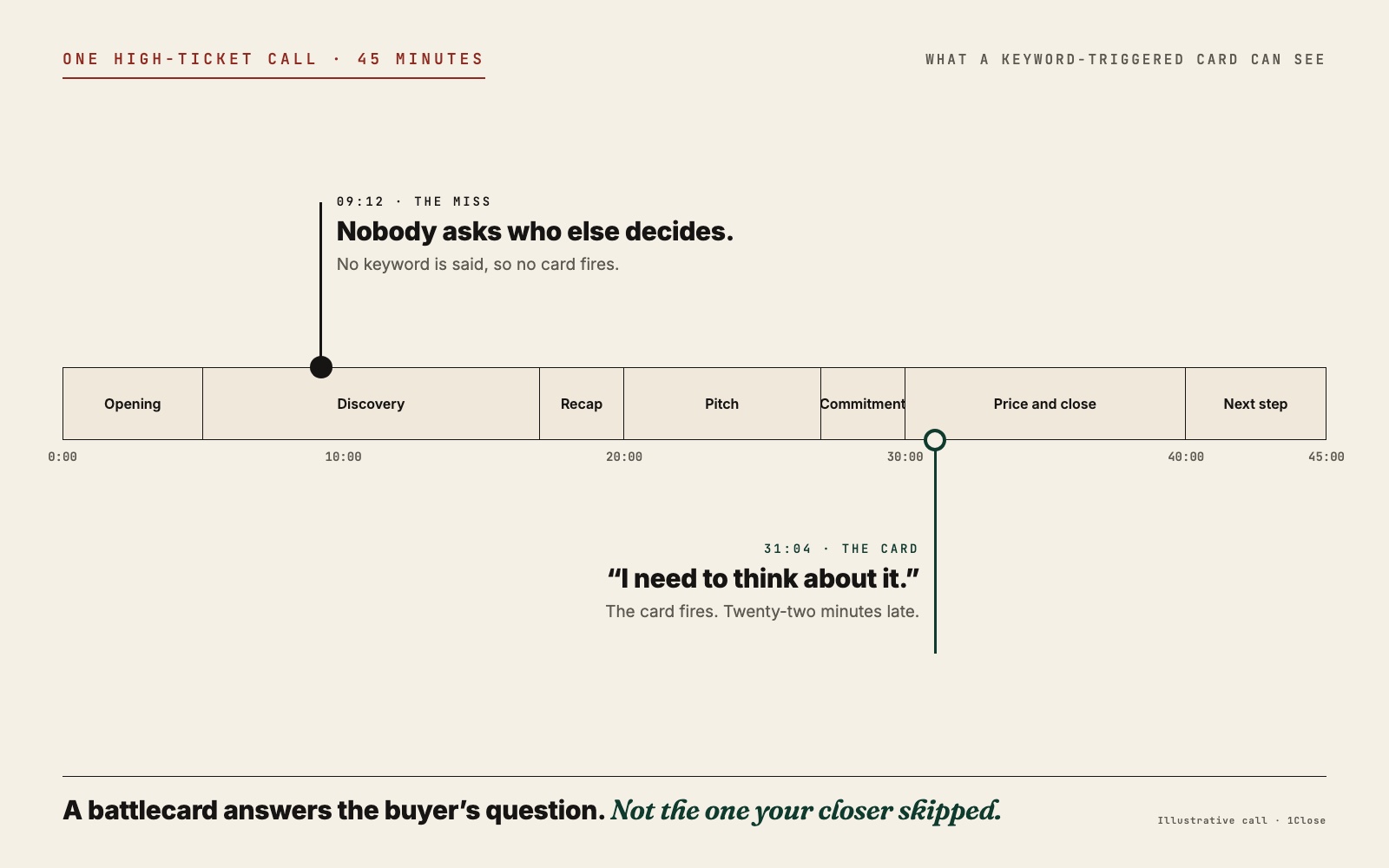
One illustrative call. The miss makes no sound, so no card fires. The card fires twenty-two minutes later.
The card fires at minute thirty-one on "think about it". The deal was lost at minute nine, when nobody asked about the wife.
A battlecard answers the question the buyer asked. A lot of high-ticket deals are lost on the question the closer didn't ask.
This is why the research finding about feedback overload matters. The fix isn't more cards. It's one move at a time, at the right moment, based on what this buyer has already said.
Mistakes teams make when buying real-time sales coaching
- Buying for the wrong call type. A contact-centre tool on a Zoom sales team, or a dialer tool for booked demos. Check "where it runs" before anything else.
- Trusting a comparison list over the vendor's own page. Including this one. Open the product page and look for the words "during the call".
- Judging the demo on the objection moment. Every vendor demos "I need to think about it". Ask what the tool does in discovery, when nothing has been said yet.
- Putting too much on the screen. The research is clear that newer reps drown. One prompt at a time beats a sidebar full of cards.
- Stopping at the live call. A prompt fixes one moment on one call. The same miss comes back on Thursday unless someone names it and your closer practises it.
So which real-time sales coaching tool is best?
It depends on where your team sells.
- A phone sales floor in a contact centre, 50+ reps: Balto, Cresta or Observe.AI.
- Outbound SDRs on a dialer: Nooks or Trellus.
- A B2B team already on Salesloft, Outreach or Salesforce: the live battlecards inside the tool you already pay for, or Revenue.io on Salesforce.
- A video-first team that wants live cards at a published price: Avoma, or Attention.
- Deal reviews and forecasting for a big team: Gong, and don't buy it for live prompts.
- A solo seller on a budget: Cluely, knowing its limits.
- High-ticket closers selling on Zoom, two to fifteen of them, where the founder can't be on every call: read the next section.
Why we built 1Close differently
I've taken over 5,000 sales calls. The deals I lost were almost never lost because I didn't have an answer. They were lost because I let the buyer run the call, or I skipped the question I knew I should ask.
So 1Close starts where the live card stops. Today it scores every sales call your team takes, names the one miss in plain words at its minute, and builds a practice call against that exact buyer, with a coach giving your closer one move at a time. The recap and the follow-up are already written, waiting on your yes. The next move on the live deal is named.
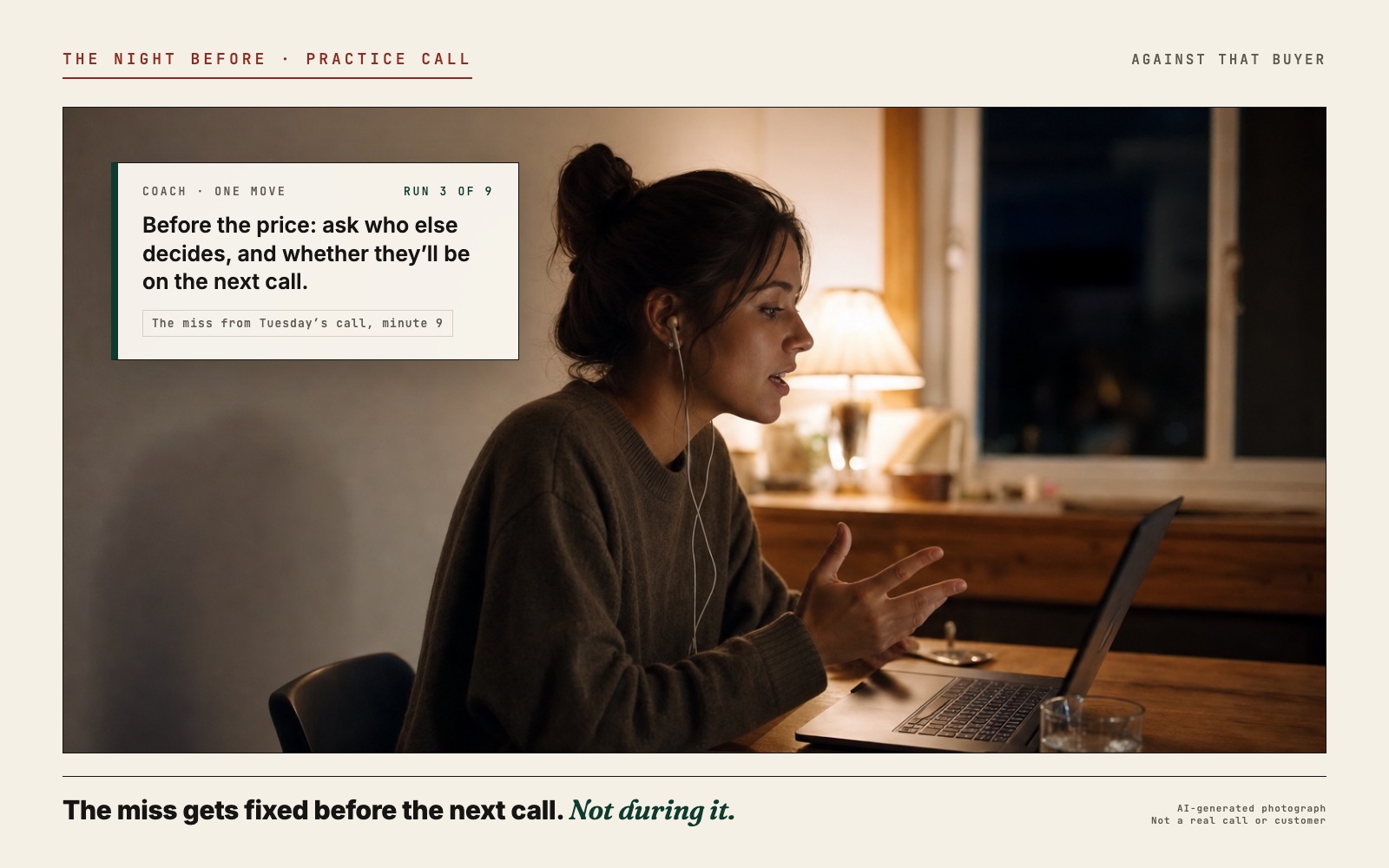
The miss from Tuesday's call becomes tonight's practice. Not a real closer or customer.
1Close has a live card on real calls too: the same coach your closers practise with, one move on screen, nothing else. It's there for extra help in the moment. It isn't where the deal gets won. A prompt on the live call is the last few percent. The practice before the call is where the miss actually gets fixed.
If your closers already know the objection answers and the deals still go quiet, the problem isn't on the card. It's in the call nobody coached, and in whose terms the call runs on. Bring one recorded call and we'll score it with you, live.
Questions people ask
What is the best AI tool for real-time coaching on sales calls?
It depends on where you sell. For contact-centre phone sales, Balto, Cresta and Observe.AI are the most mature. For outbound dialing, Nooks and Trellus. For video calls on Zoom, Meet or Teams, Avoma, Attention, Outreach Kaia and Salesloft all show live battlecards. For high-ticket closer teams, look at what happens after the call as closely as during it.
What's the difference between real-time agent assist and conversation intelligence?
Real-time agent assist shows the rep a prompt while the call is live. Conversation intelligence records the call and analyses it afterwards: transcripts, scores, trends. Gong, Chorus and Sybill are mostly conversation intelligence. Balto, Cresta and Avoma do live prompts. Many tools now do some of both.
Does Gong do real-time coaching?
On Gong's own site, the Zoom app shows a live transcript, notes and an alert if you've talked for more than 2.5 minutes. Some comparison posts describe a real-time add-on called "Gong Assist", but I couldn't find it on gong.io in September 2026. Ask Gong directly before you buy on that basis.
Can AI real-time coaching improve close rates?
The best evidence says AI help during live conversations raises output by about 15% on average and most for less experienced people (QJE, 2025), and that AI coaching helps middle-ranked salespeople most (Journal of Marketing, 2021). No independent study yet measures close rate from live sales prompts alone. Ask any vendor for a before-and-after close rate computed from real calls.
Do real-time sales coaching tools work on Zoom?
Some do. Avoma, Attention, Outreach Kaia, Cluely and Revenue.io list Zoom, Meet or Teams. Balto, Cresta and Observe.AI are built on contact-centre phone systems. Nooks and Trellus run inside dialers. Check the vendor's integrations page for your exact setup.
Is it OK to use a hidden AI assistant on a sales call?
Legally, check your own rules on recording and consent. Commercially, ask yourself how the buyer would feel if they found out. Buyers increasingly want a person to check what the AI says. A tool you'd be comfortable telling the buyer about is a safer bet.
How much do real-time sales coaching tools cost?
Most enterprise tools (Balto, Cresta, Observe.AI, Gong, Salesloft, Outreach) are custom-priced. Published prices in September 2026: Avoma from $19 a seat a month on annual billing, Kendo $55 to $100 a seat a month, Cluely from free to $149.99 a month.
Written by
George
Founder, 1Close
Building the AI sales manager. Frame State Selling on every live call.
Building the AI sales manager. Writes about high-ticket closing, frame, and how founder-led sales teams actually scale.
Frame State Selling® · Frame Intelligence Engine®
Keep reading
Sales teams bought AI. The close didn't move.
High-ticket sales statistics for 2026 from 148 sources: 87% of sales teams use AI, fewer reps hit quota, and the call is still the least-coached hour.
19 September 2026 · 8 min read
The deal didn't stall. You lost the frame.
"Let me think about it" is rarely about thinking. It's the sound of a frame you stopped holding three questions ago. Here's how to spot the handover and take it back.
12 June 2026 · 3 min read